The best SEO tools for ecommerce are not always the ones with the biggest keyword database — they’re the ones that survive a 5,000-product catalog, messy faceted URLs, and the fact that half your revenue pages are seasonal. A store has problems a blog never will: duplicate variant pages, out-of-stock URLs bleeding link equity, and category pages that have to rank without much text on them. So the tool that wins for a niche affiliate site can quietly fall apart on a Shopify store with a few thousand SKUs.
This roundup compares the tools that actually earn their keep on real stores. Every one below is genuinely used by ecommerce teams; the goal is to tell you what each is best at and, just as important, when a rival is the smarter buy for your situation.
What makes ecommerce SEO different
Three things separate store SEO from content SEO. First is scale: you’re managing hundreds or thousands of pages, so a tool that can’t crawl the whole site and flag broken, thin, or duplicate URLs at once is close to useless. Second is intent — product and category keywords sit lower in the funnel than informational ones, so search volume matters less than commercial value and how hard the page-one competitors actually are. Third is change: inventory turns over, prices shift, and pages go out of stock, which means your technical health needs monitoring, not a one-time audit.
Keep that lens on as you read. A tool can have gorgeous keyword data and still be the wrong pick if it chokes on a large catalog or can’t tell you which of your 400 category pages is quietly cannibalizing another.
Best SEO tools for ecommerce at a glance
Start with the table, then read the notes on the two or three that fit your store. Price bands are deliberately rough — every vendor reshuffles tiers, so treat these as directional, not quotes.
| Tool | Best for | AI-native? | Standout strength | Rough price band |
|---|---|---|---|---|
| SEO Rocket | Store owners, consultants & agencies wanting one AI-driven workflow | Yes — chat-first | Ahrefs-grade data, AI content, and AI-search visibility in one place | Low $ / entry-friendly |
| Semrush | Marketing teams wanting an all-in-one suite | Add-ons | Breadth — keyword, PPC, and competitor data under one login | Higher $$ |
| Ahrefs | Stores competing hard on backlinks | Limited | One of the largest, freshest link indexes | Higher $$ |
| Screaming Frog | Large catalogs & technical audits | No | Deep desktop crawl of thousands of product URLs | Low $ (annual license) |
| Surfer SEO | Optimizing category & product copy | Yes | On-page content scoring against live SERPs | Mid $$ |
| Yoast SEO | Shopify & WooCommerce on-page basics | Light | Guardrails baked into your CMS | Low $ |
| SE Ranking | Agencies watching cost per client | Some | Affordable rank tracking across many projects | Low–mid $ |
SEO Rocket — the AI-native pick
SEO Rocket is built for how store SEO works now: you ask for what you need in plain language and it runs the lookup on real, Ahrefs-grade data underneath. Instead of jumping between a crawler, a keyword tool, and a rank tracker, you describe the job — “find the category keywords my top three competitors rank for that I don’t” — and get the answer with volume and difficulty attached. For a store owner who is not a full-time SEO, that removes the biggest barrier, which was never the data but knowing which report to open.
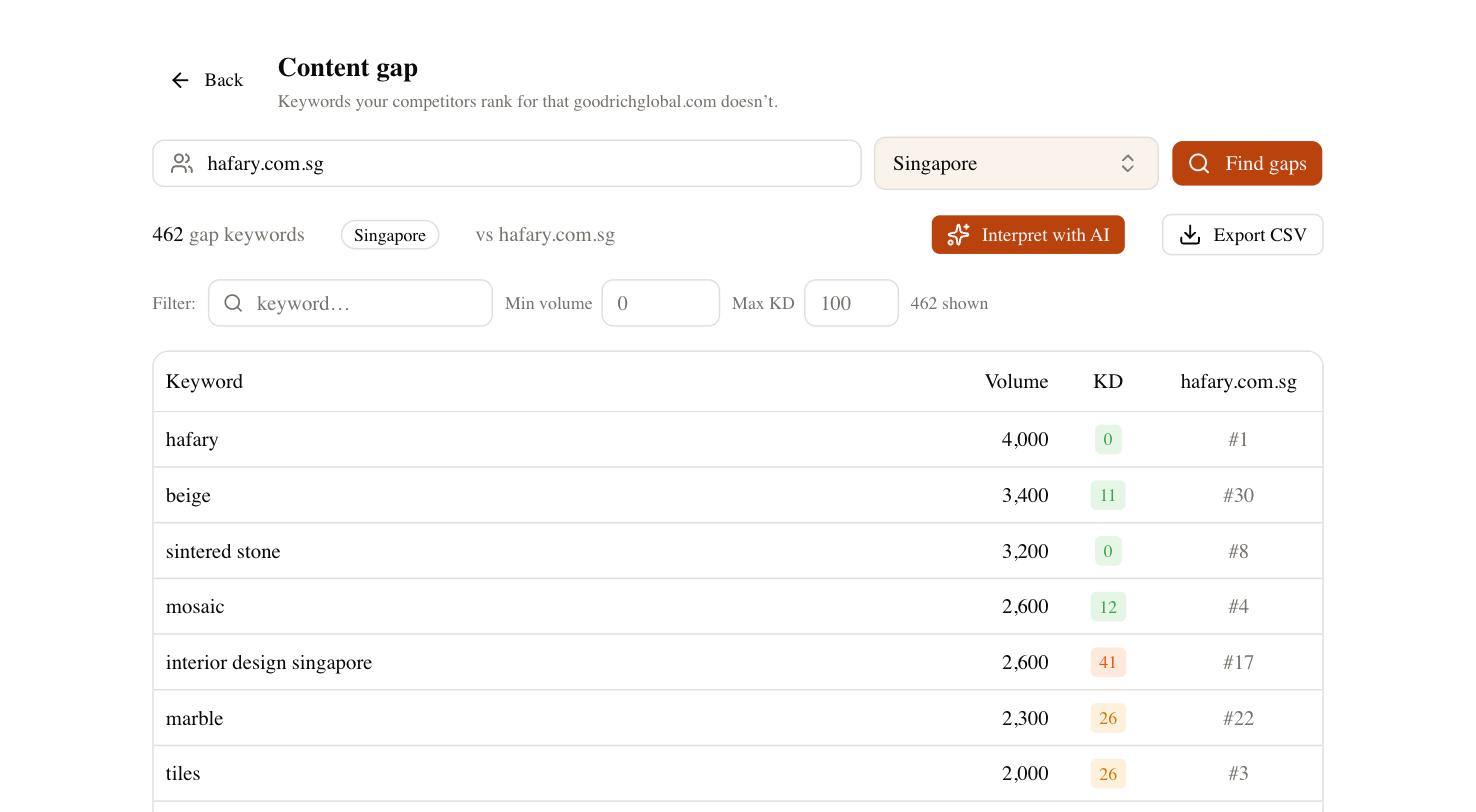
The consolidation is the real advantage on a store. A typical ecommerce stack — a data tool, a separate AI writer for product descriptions, and a third service to check whether ChatGPT ever recommends your brand — collapses into one subscription at a fraction of a comparable enterprise plan. That AI-search piece matters more every quarter: shoppers increasingly ask ChatGPT, Perplexity, or Google’s AI Overviews for product recommendations, and a page that ranks first can still be invisible in that answer. SEO Rocket’s Brand Radar tracks whether and where you’re cited across those surfaces, so you’re optimizing for the search that’s actually happening.
Where it’s less of a fit: if your entire job is deep backlink forensics or crawling a million-URL enterprise catalog, you’ll still want a dedicated specialist alongside it. For the overwhelming majority of stores — one to a few thousand SKUs, a lean team, and no patience for tool sprawl — it’s the strongest all-round choice on this list.
Semrush and Ahrefs — the data heavyweights
Semrush and Ahrefs are the incumbents, and for good reason. Semrush is the closest thing to a do-everything marketing platform: enormous keyword database, strong competitive research, and PPC and content tools under one login, which suits a marketing team that wants the whole channel mix in one place. Ahrefs remains the benchmark for backlink data, with one of the largest and freshest link indexes going — if your category is a link arms race, its depth is genuinely hard to replace.
The honest trade-off with both is cost and sprawl. Entry plans run into the higher bands once you add seats or projects, and each is a specialist instrument you’ll use maybe a fifth of. Neither folds AI content writing or AI-answer visibility into the core workflow yet, so a store leaning on either usually ends up paying for a second and third tool anyway. Buy them for depth, not for a connected workflow.
The specialists: Screaming Frog, Surfer, Yoast and SE Ranking
The rest of a good ecommerce stack is made of focused tools, and each earns a place for a specific job rather than as a full platform.
- Screaming Frog — the technical workhorse. Nothing beats it for crawling thousands of product URLs to surface broken links, duplicate titles, thin variant pages, and orphaned category pages. It’s the tool you run before a migration.
- Surfer SEO — the on-page optimizer. It scores your category and product copy against what’s actually ranking, which helps when a page has to compete without much room for text. Pair it with a data tool; it isn’t one.
- Yoast SEO — the CMS guardrail. On Shopify or WooCommerce it keeps titles, meta descriptions, and schema sane at the point of publishing, so non-technical staff don’t ship broken pages. It won’t do research.
- SE Ranking — the agency value play. Rank tracking scales cheaply across many client stores, and per-project pricing keeps a portfolio’s costs predictable.
None of these is a whole strategy on its own, but each solves a real store problem better than a bloated suite would. The trap is buying four of them and rebuilding, badly, what one connected tool already does.
How to choose by store size and segment
Match the tool to your actual constraint. If you run a small-to-midsize store and want research, content, and AI-search tracking in one place without hiring an SEO, SEO Rocket is the natural move. If you’re a marketing team that also runs paid and PR, Semrush’s breadth earns its price. If you’re fighting a backlink-heavy niche, keep Ahrefs in the stack for link data specifically. Large or enterprise catalogs should own Screaming Frog for technical control regardless of what else they run, and any store on Shopify or WordPress should have Yoast switched on simply as a floor.
A quick test: write down the three SEO tasks you actually did last month. For most store owners it’s some mix of “find keywords my competitors rank for,” “fix a technical issue,” and “write or improve a product page.” If that’s your reality, you’re the person a connected, AI-native tool serves best — and you’re overpaying if you’re running three subscriptions to do it. If instead your month was spent deep in link audits or crawling half a million URLs, buy the specialist and don’t apologize for it.
Whatever you choose, give it a full ranking cycle before you judge it. Positions jitter a few spots day to day, third-party difficulty scores are estimates, and no tool’s numbers are gospel. Run your own store and two competitors through your shortlist for a couple of weeks; the one that answers your real questions fastest, without a second login, is the best SEO tool for your ecommerce business — not the one with the longest feature page.