
Most articles about a content calendar template for SEO describe one at length and never hand you the thing itself. This one does the opposite: below is a filled example table you can copy row for row, a per-post checklist to run before anything gets published, and an honest note on how often to hit publish. You will leave with a working calendar, not a lecture about why you need one.
A calendar matters because SEO rewards consistency and punishes the scramble. When you plan a quarter in advance, every post targets a keyword you chose on purpose, supports a cluster instead of floating alone, and ships on a date you can actually staff. The reason a good content calendar template for SEO works is boring but real — it turns a vague intention to “write more” into a list of specific, assignable jobs with dates attached.
What every column needs to earn its place
A calendar with thirty columns gets abandoned by week two. Keep only the fields that change a decision. In practice that means the target keyword and its rough search volume, the search intent behind it, the content type you will produce, the cluster or pillar it supports, an internal-link target, the owner, the publish date, and a status. Everything else — word count guesses, meta descriptions, tag taxonomies — belongs in the draft itself, not the planning grid.
The intent column is the one people skip and later regret. A keyword like “best running shoes” is commercial and wants a comparison; “how to clean running shoes” is informational and wants a how-to. Guess wrong and you can write a technically flawless page that ranks nowhere, because it answers a question no searcher was asking. Tagging intent up front forces that decision before a writer spends a day on the wrong format.
The template: a filled example you can copy
Here is one month of a real calendar for an imaginary running-shoe store, filled in the way yours should be. Copy the headers into a spreadsheet, replace the rows with your own keywords, and you have a live plan. The point of showing it filled rather than blank is that the example teaches the pattern faster than any instruction — notice how intent drives the content type, and how each post points at a link target so the cluster ties together.
| Publish date | Target keyword | Vol. | Intent | Content type | Cluster | Internal link to | Owner | Status |
|---|---|---|---|---|---|---|---|---|
| Aug 4 | best trail running shoes | 18k | Commercial | Comparison roundup | Buying guides | /trail-running-guide | Maya | Published |
| Aug 11 | how to clean running shoes | 9.4k | Informational | How-to guide | Care & maintenance | /running-shoe-care | Dev | In draft |
| Aug 18 | running shoes for flat feet | 6.1k | Commercial | Buyer’s guide | Buying guides | /best-trail-running-shoes | Maya | Outlined |
| Aug 25 | how long do running shoes last | 4.8k | Informational | Explainer | Care & maintenance | /how-to-clean-running-shoes | Dev | Idea |
Four posts a month is a realistic starting cadence for a small team, and the table above is deliberately modest for that reason. Notice that the two informational posts feed the care cluster while the two commercial posts feed the buying cluster, and each links to a sibling — that is how you build topical depth instead of a pile of unconnected articles. Scale the row count to your capacity, never to your ambition.
The per-post checklist to run before publishing
The calendar decides what to write; the checklist decides whether a piece is ready. Run every draft through the same short list so quality does not depend on who happened to write it that week. This is the checklist that separates posts that rank from posts that merely exist, and it takes about ten minutes per article once it becomes habit.
- Primary keyword appears in the title, the first 100 words, one H2, and the URL slug — present, never stuffed.
- Search intent matches the format: a comparison query gets a comparison, not a 3,000-word essay.
- The page beats the weakest result currently ranking on page one, not the strongest — that is the real bar to clear.
- At least two internal links point in from existing pages, and two point out to cluster siblings.
- A meta title under 60 characters and a description between 140 and 155 characters are written by hand.
- Every claim that needs a source has one, and any statistic is dated.
- The post answers the question in the first screen, before any preamble.
Keep the list this short on purpose. A checklist people finish is worth more than a thorough one they skip, and each item here maps to a reason pages fail to rank rather than to a generic quality ideal. Add your own row only when you catch the same mistake twice.
How often should you actually publish?
Cadence is where most calendars quietly break. The honest answer is that publishing frequency matters far less than sustained frequency — one strong post a week for a year beats ten in January and silence until March. Google has no fixed quota, and there is no ranking bonus for hitting an arbitrary number; there is only the compounding benefit of a growing, interlinked library that you keep fresh.
Pick the number you can hold through a busy quarter, then protect it. If that is two posts a month, plan two. A calendar that promises eight and delivers three does more damage than a modest one delivered in full, because the gaps train everyone to treat the plan as optional. Build in refresh slots too — updating a post that has slipped from position 4 to 9 often returns more traffic than a brand-new article.
Filling the calendar with real keyword data
A blank template is only as good as the keywords you pour into it, and this is the step that usually stalls a plan for weeks. You need volumes, difficulty, and intent for a whole cluster at once, and pulling those one query at a time from a traditional tool is slow enough that people give up and guess. Guessing is how you end up with a tidy calendar full of keywords nobody searches for.
This is where SEO Rocket changes the shape of the work. You describe the topic in plain language — “plan a quarter of running-shoe content” — and it runs the keyword research on real, Ahrefs-grade data, groups the results into clusters, tags likely intent, and hands back rows you can drop straight into the grid above. The competitor-gap view then shows which of those keywords your rivals rank for and you do not, so the calendar fills with proven demand instead of hunches.
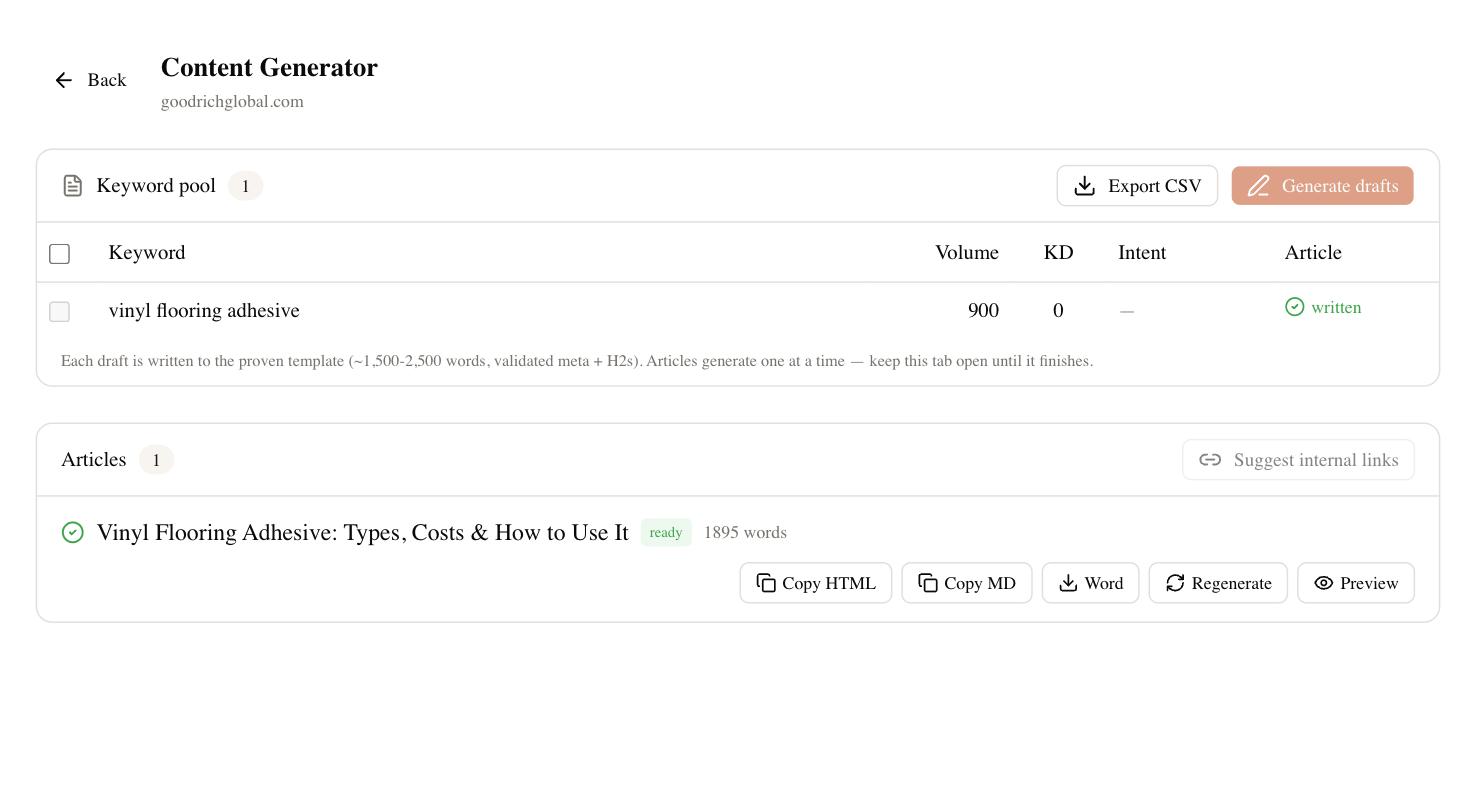
From there the same tool drafts the post. Point it at a filled row and it produces a title, a meta description in the right character range, and a heading structure that follows the intent you tagged — the checklist above, applied automatically before a human ever opens the draft. You still edit for voice and accuracy, but the blank-page tax that kills most calendars is gone. What used to be a week of research and setup becomes an afternoon of review.
Common mistakes that kill a content calendar
Three failure patterns show up again and again. The first is planning by volume alone — chasing the 40,000-search head term while ignoring the specific long-tail queries your buyers actually type, which are easier to rank for and convert better. The second is the orphan post: a well-written article that links to nothing and is linked from nothing, stranded outside every cluster. The third is treating the calendar as a to-do list you clear rather than a portfolio you maintain, so nothing ever gets refreshed.
All three come from the same root — mistaking activity for strategy. A calendar is not a proof that you are busy; it is a bet on which topics will earn traffic and how they will reinforce each other. Fix the strategy and the schedule takes care of itself.
Turning the template into a system
Copy the table, adopt the checklist, and pick a cadence you can hold — that alone puts you ahead of most sites, which publish reactively and wonder why nothing compounds. The template is not sacred; strip a column that never changes a decision, add one your team keeps forgetting. The only rule that matters is that every row ties a specific keyword to a specific date, owner, and cluster.
Where a tool earns its keep is in removing the two steps that make people abandon the plan: finding the keywords and filling the blank page. If you would rather spend your hours editing than researching and formatting, let SEO Rocket populate the grid and draft the first version, then bring your judgment to the part that actually needs a human. Give any calendar a full quarter before you judge it — SEO compounds slowly, and the plan you keep beats the perfect one you drop in week three.