If you want to know how to check AI Overview visibility, the short version is this: you search the way your customers do, you read who Google actually cites in the AI-generated answer at the top, and then you track it over time so a one-off snapshot doesn’t fool you. Knowing how to check AI Overview visibility matters now because AI Overviews sit above the classic blue links for a growing share of queries, and a page can rank first the old way while being completely absent from the answer most people read first.
This guide walks through the exact steps you can run today, by hand and with tooling, plus an honest note on how long results take and where the checks fall short. No fluff, no promises that you’ll appear in every answer by Friday.
What “AI Overview visibility” really means
An AI Overview is the summarized answer Google generates at the top of some results pages, stitched together from multiple sources and shown with a handful of linked citations. Visibility here is not the same as your keyword ranking. It’s a yes-or-no question first — does the Overview even appear for this query — and then a second question: are you one of the sites it cites and links to?
Those citations are what you’re chasing. When Google names your page as a source, you get a link, brand exposure, and a shot at the click even when the user got their answer inline. When it doesn’t, you’re invisible on that query no matter how well your page ranks below the fold. That gap between “ranks well” and “gets cited” is the whole reason this check exists. It’s also why you can’t infer visibility from your rank report alone — the two are related but they are not the same signal, and only one of them tells you whether you’re in the answer people actually read.
Why it’s harder to measure than normal rankings
Traditional rank tracking is stable enough to trust: a keyword sits at position four, and it’s roughly there tomorrow. AI Overviews behave differently. They don’t fire on every query, they’re personalized by location and search history, and the same search can return an Overview for you and none for the person next to you. Google also rolls them out unevenly by region and topic, so a query that triggers one in the United States may show nothing in another market.
That volatility means a single manual check tells you almost nothing on its own. You need to search from a clean session, repeat across a set of real queries, and watch the pattern over weeks rather than reacting to one screenshot. Treat any one result as a data point, not a verdict. The Overview text itself also regenerates, so the exact wording and even which sources get cited can shift between two searches an hour apart. Your job is to spot the durable pattern underneath that noise, not to chase every flicker.
How to check AI Overview visibility, step by step
Here’s the process you can run right now. Steps one through four are free and manual; step five is where a tool saves you the grind.
- Build a query list. Write down 15 to 30 searches your buyers actually type — questions, comparisons, and “best X for Y” phrasing, not just your head terms. Informational and question-style queries trigger Overviews far more often than transactional ones, so lean that way.
- Search from a clean session. Open an incognito or private window and, if you can, set your location to the market you care about. Personalization skews what you see, so a logged-out session gets you closer to a neutral result.
- Check whether an Overview appears. For each query, note simply: did an AI Overview show up, yes or no? This alone tells you which of your topics are even in play. No Overview means there’s nothing to be cited in yet.
- Read the citations and look for yourself. Where an Overview appears, expand it and read the linked sources. Record whether your domain is cited, which specific page got the nod, and which competitors are showing up instead of you. That competitor list is your shortlist of pages to study and beat.
- Track it over time. Log each check in a spreadsheet or a tracking tool, then repeat the whole set every couple of weeks. Visibility drifts as Google retunes its models, so the trend line matters far more than any single day.
Do this manually and you’ll get real answers, but it’s slow, and honestly it doesn’t scale past a handful of keywords. Thirty queries checked by hand every two weeks is an afternoon you’ll quietly stop spending. That’s the point where most people either give up or reach for a tool.
Where a tool does the grinding for you
SEO Rocket handles this with a feature called Brand Radar — its AI-visibility tracker. Instead of you opening incognito tabs one query at a time, it runs your keyword set across AI surfaces and reports back whether your brand is being cited, where, and how that’s changing. It covers Google AI Overviews alongside ChatGPT and Perplexity, because the same buyers who read an Overview today ask an assistant tomorrow, and you want one view of both.
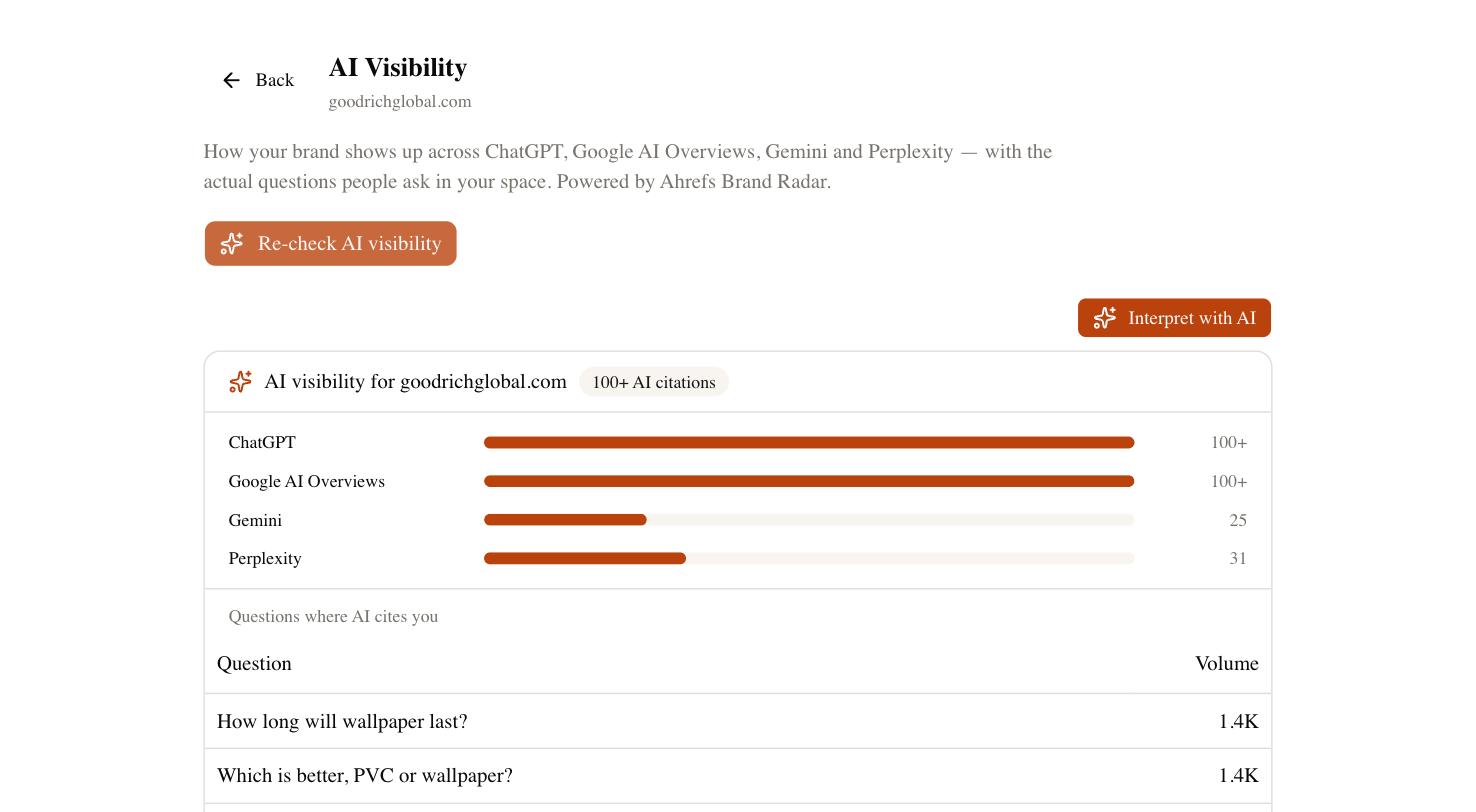
The practical payoff is the trend, not the snapshot. Because it re-checks on a schedule, you see whether a content change actually moved your citation rate weeks later, and you see which competitors keep getting named so you know whose pages to reverse-engineer. You ask for it in plain language — the same chat-first workflow that runs your keyword research and rank tracking — so the AI-visibility check lives next to the rest of your SEO work instead of in a separate login. It won’t get you cited on its own; what it does is replace the manual grind and give you a straight answer to “is this working.”
A quick visibility checklist
Before you call a query “covered,” run it against this short list. It keeps you honest about what you’re actually measuring.
- Does an AI Overview trigger for the query at all, in your target market?
- Is your domain among the cited sources, or just a competitor’s?
- Which exact page is being cited — and is it the one you’d want?
- Are you checking from a clean, location-correct session?
- Do you have at least two data points across different weeks, not one?
If you can’t answer all five, you don’t yet have a reading you can act on. That’s fine — visibility is a moving target, and a rough map beats a precise measurement of a single lucky day.
Be honest about timelines and limits
Two things worth saying plainly. First, appearing in AI Overviews takes time. Google typically cites pages it already trusts and ranks, so the work is the same durable stuff — genuinely useful content, clear structure, real authority — and that compounds over months, not days. There’s no toggle that adds you to the answer. Second, no tool, including SEO Rocket, sees exactly what every individual user sees. Overviews are personalized and non-deterministic, so any tracker gives you a strong directional signal, not a guarantee that your citation showed for a specific person at a specific moment.
The other honest limit is coverage. Overviews still don’t appear for every query or every country, and Google keeps changing when they fire. So part of the answer to visibility is simply “this topic doesn’t trigger one yet” — which is useful to know, because it tells you to keep optimizing for the classic result instead of chasing an answer box that isn’t there.
Turn the check into a habit
The mistake is treating this as a one-time audit. Run your query set today to get a baseline, note which searches trigger an Overview and where you’re cited, then re-check every two to three weeks. Pair each cycle with one concrete improvement to a page that a competitor is being cited for instead of you — tighter answers near the top, cleaner headings, a fact or two that reads as genuinely authoritative. Over a few cycles you’ll see whether your citation rate is climbing, flat, or slipping, and that trend is the real measure of whether your AI-search visibility is improving. Check consistently, act on the gaps, and let the compounding do the rest.