Figuring out how to check brand in ChatGPT matters now because a growing share of your buyers ask an assistant before they ever open Google. If someone types “best accounting software for freelancers” into ChatGPT and your product never comes up, you have lost that customer silently — no impression, no click, no line in your analytics to warn you.
The good news is that checking is not complicated. You do not need a special integration or an API key to start. Below is a repeatable process you can run in the next twenty minutes, plus an honest read on what the results mean and how long it realistically takes to move them. Knowing how to check brand in ChatGPT is the first step to being recommended by it.
Why this is worth your time
Traditional rank tracking tells you where your page sits in a list of blue links. It says nothing about whether an AI assistant names you when it answers a question. Those are different games. A page can rank third on Google and still be completely absent from ChatGPT’s reply, because the model draws on its training data, its browsing results, and whatever sources it decides to cite — not on your position in the classic index.
So the point of checking is simple. You want to know three things: whether ChatGPT mentions you at all, whether it says accurate things about you, and which competitors it names instead. Get those three answers and you know exactly where the work is.
What “checking your brand” actually means
There are two layers worth separating. The first is direct: you ask ChatGPT about your company by name and see what it knows. This catches outdated facts, wrong pricing, or a description that no longer fits what you sell. The second layer is the one that drives revenue: you ask the questions your customers ask — without naming yourself — and see whether you surface unprompted.
The second layer is harder and more valuable. Being described correctly when someone already knows your name is table stakes. Being recommended when they do not know you yet is the growth. Both are worth measuring, and both change over time as the model updates and as your presence on the wider web shifts.
How to check your brand in ChatGPT, step by step
Run these steps in order. Keep a simple spreadsheet open so you can log what you find — the record is what makes the check repeatable rather than a one-off curiosity.
- Start a clean session. Open a fresh chat, and if you can, turn off any memory or personalization features. Your own history skews results toward what the model already associates with you, and you want the neutral answer a stranger would get.
- Ask about your brand directly. Try “What is [your brand]?” and “What does [your brand] do?” Note whether the description is accurate, current, and flattering. Copy the exact reply into your sheet with the date.
- Ask the buying questions. Now drop your name. Use the real phrases customers use: “best [category] tool for [audience],” “alternatives to [big competitor],” “affordable [product type].” See whether you appear at all, and where in the list.
- Check the sources. If browsing is on, ask “Which sources did you use?” ChatGPT will often list the pages it cited. Those citations tell you which sites are shaping the answer — frequently review roundups, comparison posts, and Reddit threads, not your own homepage.
- Test the follow-ups. Real users refine. After a first answer, ask “Any others?” or “Which is best for a small team?” Your brand may be absent from the first reply but surface on the second — that is still a meaningful position, and worth logging.
- Vary the phrasing and repeat. Ask the same intent three different ways. Answers shift between runs because there is randomness in how the model responds, so one reply is an anecdote and three is a pattern. Record all of them.
- Repeat across surfaces. The same questions in Perplexity and in Google’s AI Overviews will give different answers, because each system cites differently. If you only check ChatGPT you see a third of the picture.
That is the whole manual method. It costs nothing and it works. Its only weakness is that it does not scale — which is where a tool earns its place.
How to read the results honestly
Do not overreact to a single bad answer. Because responses vary run to run, one absence does not mean you are invisible and one mention does not mean you have won. Look at the pattern across your repeats. If you appear in one reply out of six, you have a weak but real presence. If you never appear across a dozen varied prompts, that is a genuine gap.
Pay attention to the sources too. When ChatGPT names competitors, it is usually echoing third-party pages that mention them and not you — listicles, “best of” roundups, forum threads. That tells you the fix is rarely on your own site alone. It is about getting credibly mentioned on the pages the model already trusts, which is slow, earned work, not a setting you can toggle. Note the wording as well: if the model describes you with a stale tagline or an old price, that is a content problem you can fix directly by updating your own pages and making sure the accurate version is easy to find.
Tracking it without doing it by hand
The manual check is perfect for a first look and for spot-checking one product. It falls apart when you have dozens of prompts, several markets, and three assistants to watch every week. Doing that by hand is an hour you will not spend twice, and memory drift makes it hard to say whether things improved.
This is the job SEO Rocket’s AI Visibility feature — Brand Radar — is built for. You give it the prompts your customers actually use, and it runs them on a schedule across ChatGPT, Perplexity, and Google’s AI Overviews, then records whether you were cited, where, and alongside which competitors. Instead of re-reading a wall of chat replies, you get a trend line: citation share this week versus last, and which prompts you are winning or losing.
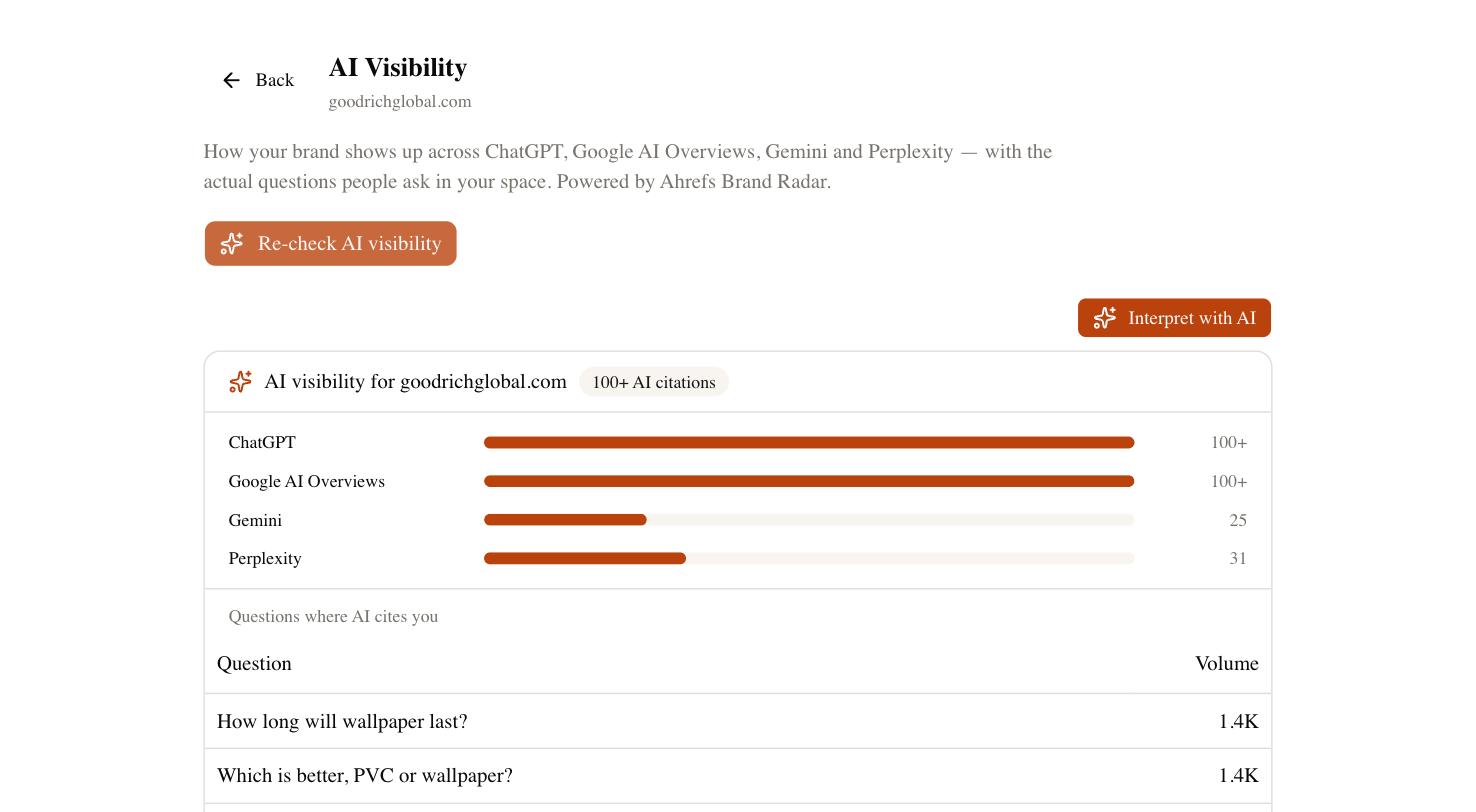
The value is not that it does anything you could not do by hand — it is the consistency. The same prompts, run the same way, on a cadence, so a change you make in July can be measured in August against a real baseline rather than a memory. It also surfaces the competitors that keep appearing in your place, which is the most direct list of who to study. It will not make ChatGPT recommend you overnight; nothing does. What it gives you is an honest instrument so you are not guessing.
How long change actually takes
Set expectations before you start optimizing. When you publish a new comparison page or earn a mention on a site ChatGPT trusts, the model does not update the next morning. Browsing-enabled answers can pick up fresh pages within days to a few weeks, but the model’s baked-in knowledge only shifts when it is retrained, which happens on the provider’s timeline, not yours. Plan in months, not days.
That lag is a reason to start checking now rather than later. The sooner you have a baseline, the sooner you can tell whether your content and outreach are actually moving the needle. Waiting until you are curious means waiting until a competitor already owns the answer.
A simple weekly checklist
Keep it light so you actually do it. This is enough to catch problems early without turning into a second job.
| Check | How often | What you are looking for |
|---|---|---|
| Direct brand question | Monthly | Accurate, current description; correct pricing and positioning |
| Top 5 buying prompts | Weekly | Whether you appear, and in what position |
| Cited sources | Weekly | Which third-party pages shape the answer |
| Competitor mentions | Weekly | Who keeps getting named in your place |
| Other assistants | Monthly | Whether Perplexity and AI Overviews agree with ChatGPT |
Start with the manual method this week to learn what your customers are seeing, then move the repetitive parts onto a tracker once you know which prompts matter. The habit is what counts. Brands that watch their AI visibility early get to fix the gaps quietly, long before the ones who never thought to look.