
If you have ever published a dozen solid articles and still watched a thinner competitor outrank you, the missing piece is usually structure, not effort. Learning how to build a topical map is how you fix that: instead of chasing one keyword at a time, you plan the full set of pages that prove to Google you cover a subject completely.
A topical map is a plan you work from, not a spreadsheet you file away and forget. This guide walks through the exact steps, names the one tool inside SEO Rocket that does the tedious part for you, and stays honest about how long the payoff really takes. You can start today with nothing but a blank document and have a usable first draft of your map by the end of an afternoon.
What a topical map actually is
A topical map is the complete set of pages you would need to publish to become the obvious authority on a subject. At the center sits your core topic — say, “email marketing.” Around it sit the subtopics a genuine expert would cover: deliverability, list growth, automation, subject lines, compliance, and so on. Under each subtopic sit the individual articles that answer specific questions.
It is easy to confuse this with a keyword list, but the two are not the same thing. A keyword list is a pile of phrases sorted by volume. A topical map is those phrases organized by how they relate to each other and to a buyer’s journey — which pages support which, which one is the pillar, and where a reader lands next. The organization is the value. Search engines reward sites that demonstrate depth and internal coherence, and a map is how you build both on purpose instead of by accident.
The practical benefit shows up in two places. First, you stop writing pages that compete with your own — when the map is drawn, you can see at a glance whether a new idea is a fresh page or a section of an existing one. Second, you write faster, because every article has a defined job and a set of siblings to link to before you open the editor. A page written in isolation has to justify itself from scratch; a page written from a map arrives with its context already built.
How to build a topical map, step by step
Here is the workflow I use on real client sites. Work through it in order — each step feeds the next, and skipping ahead is how maps end up lopsided.
- Name your central entity. Write down the one subject you want to own and, in a sentence, how it makes you money. “Project management software for agencies” is a business; “productivity” is a hobby. The tighter the entity, the more winnable the map.
- Brainstorm the subtopics first, keywords second. List the 8–15 areas a true expert would cover, before you look at any data. This keeps breadth honest — you want the full shape of the subject, not just the phrases that happen to have high volume.
- Pull real keyword data for each subtopic. Now attach numbers. For every subtopic, gather the specific queries people actually type, with monthly search volume and keyword difficulty, so you know which clusters are reachable and which are a two-year fight.
- Sort every query by search intent. Tag each one informational, commercial, or transactional. A single page cannot serve “what is X” and “buy X” well, so this tagging tells you how many distinct pages a cluster really needs.
- Decide pillars versus supporting pages. The broad, high-intent term becomes a pillar page; the narrow questions become supporting articles that link up to it. This is the skeleton of your internal linking before you have written a word.
- Find the gaps your competitors already fill. Compare your planned map against sites already ranking. The topics they cover and you have not are your fastest, most defensible wins.
- Sequence the publishing order. Rank the pages by a mix of reachability and commercial value, then commit to finishing one full cluster before starting the next.
Steps one through five you can do with a document and any keyword tool. Step six is where most maps stall, because eyeballing competitor coverage by hand across dozens of URLs is slow and unreliable. That is the part worth automating.
Use Content Gap to find what you are missing
Inside SEO Rocket, the feature that does step six is Content Gap. You give it your domain and two or three competitors, and it returns the keywords those competitors rank for that you do not — each with real search volume and difficulty pulled from Ahrefs-grade data, not guesses. Instead of manually crawling rival sitemaps, you get a ranked list of the subtopics your map is missing.
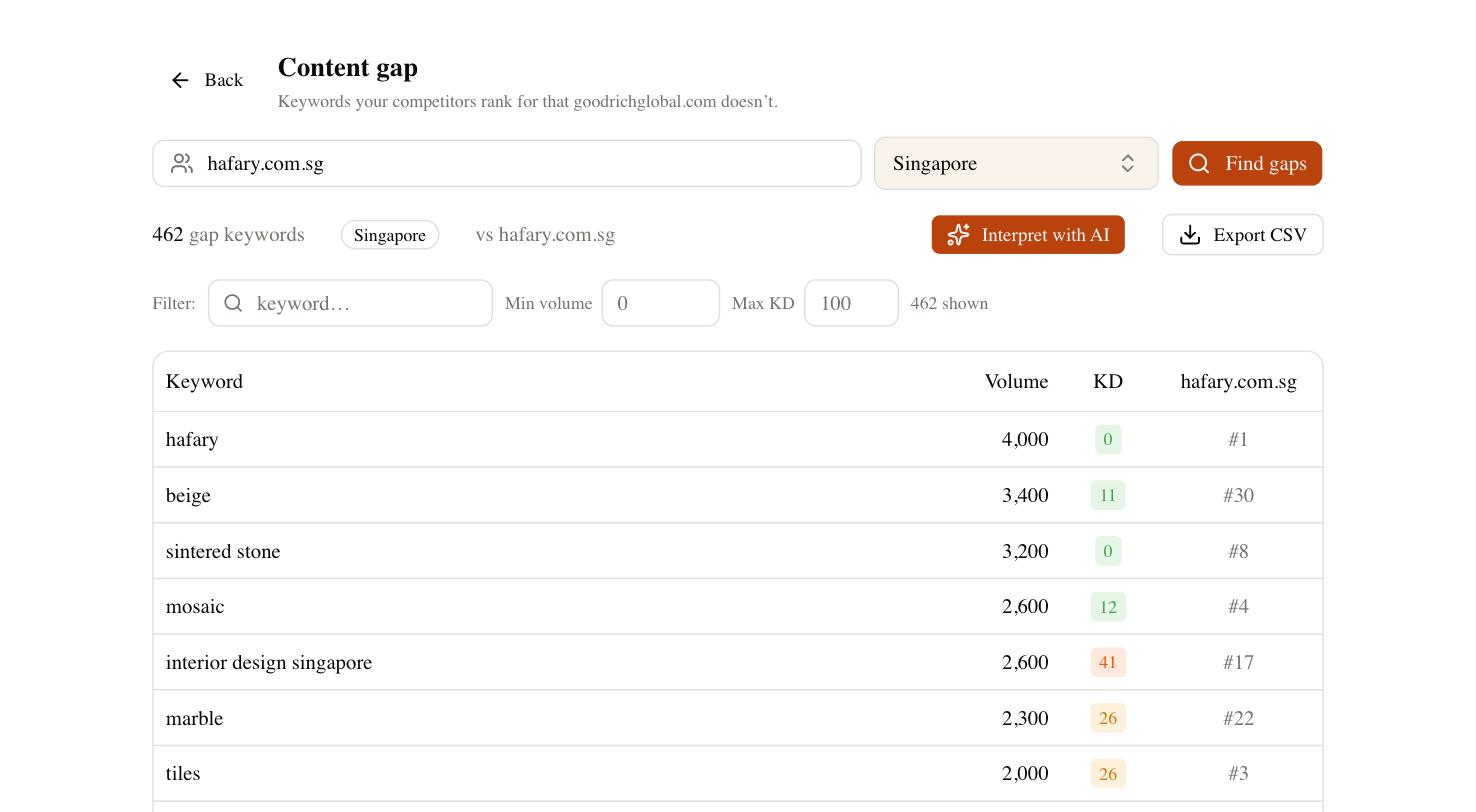
What makes this genuinely useful for mapping is that the gaps arrive already grouped, so you can see whole clusters you have overlooked rather than isolated keywords. Because SEO Rocket is chat-first, you can ask it in plain language to filter those results — say, only queries under a difficulty of 30, or only commercial-intent terms — and fold the survivors straight into your map. It will not write the map for you, and it should not; the strategic call about what your business should own is still yours. But it removes the hour of tab-juggling that usually kills the exercise, and it keeps the data honest about which gaps are actually within reach.
Turn the map into a publishing calendar
A map that lives in a spreadsheet does nothing. The step people skip is converting it into a dated schedule they will actually follow. Take your sequenced list and assign each page a target month, grouping by cluster so that related articles ship close together and can link to each other on day one.
Resist the urge to publish one article from ten different clusters. Topical authority comes from covering a subtopic thoroughly before you move on, so finish a cluster — pillar plus its supporting pages — and let it settle before opening the next. A realistic pace for a solo operator is one cluster of four to six articles per month; a small team can run two. Whatever the pace, the order matters more than the speed.
How long topical authority actually takes
This is where honesty separates a useful guide from a sales pitch. Building the map takes an afternoon. Seeing rankings from it takes months. New pages typically spend the first several weeks bouncing around before they settle, and a competitive cluster can take three to six months to mature — longer in crowded niches like finance or health, where even a complete map fights entrenched authority.
Expect movement, not magic. Positions jitter a few spots day to day regardless of what you do, so judge a cluster by its trend over a month, not by yesterday’s rank check. The map does not make ranking faster on any single page; it makes the whole effort compound, because each new article strengthens the ones around it instead of standing alone.
A quick checklist before you publish
Before you commit a single article to the calendar, run it against a short sanity check. If any answer is no, the page is not ready for the map yet.
- Does this page have one clear intent, not two stapled together?
- Does it link up to its pillar and across to at least one sibling in the cluster?
- Is the target query actually reachable given your current authority, or is it a two-year term you should park?
- Does it cover the subtopic more completely than the weakest page currently ranking on page one?
- Does it fill a real gap, or duplicate something you already published?
That last question matters more than it looks. Maps rot when you write two thin pages that should have been one strong one, and cannibalization quietly caps both. When in doubt, merge and go deeper.
Start small, finish the cluster
The whole point of learning how to build a topical map is to stop publishing at random and start publishing on purpose. You do not need the entire map perfect before you begin — you need one well-defined entity, one cluster mapped in full, and the discipline to finish it before chasing the next shiny keyword. Get the first cluster ranking and the second one comes faster, because the site around it is already stronger.
Open a document, name your central topic, and list the subtopics from memory. Then run your domain and two competitors through Content Gap to catch what you missed, sort the results by intent and difficulty, and pick the single cluster you will finish first. That is a real map, built today, and it will outperform another year of scattered posts.