
A content strategy for ai search is not a rebrand of the SEO playbook you already run. The job has quietly changed: a growing share of your buyers now ask ChatGPT, Perplexity, or Google’s AI Overviews a question and read the synthesized answer instead of clicking ten blue links. If your page ranks first but never gets pulled into that answer, you are invisible to those people — and no amount of traditional on-page tuning fixes it on its own.
So a real content strategy for ai search starts from a blunt premise: you are no longer only competing for a ranking position, you are competing to be the source an answer engine trusts enough to quote. That is a different target, and it rewards different moves. This guide covers what makes this niche distinct, the handful of things worth most of your effort, and the mistakes that quietly keep good pages out of AI answers.
Why AI search is a different game
Classic SEO optimizes for a ranked list. The engine returns links, the human decides. AI search collapses that: a model reads dozens of pages, extracts what it judges to be factual and well-supported, and writes one answer with a few citations. Your page is no longer the destination — it is raw material the model may or may not use.
That shift changes what “good content” means. A ranking model tolerates fluff if the signals around it are strong. A generative model, by contrast, is trying to lift a clean, quotable claim out of your page and attribute it. Vague, padded, hedge-everything writing gives it nothing to grab. The pages that get cited tend to state things plainly, back them with specifics, and make the answer easy to extract without the model having to guess what you meant.
The second difference is volatility. Rankings jitter a few spots day to day, but AI citations are far less stable — ask the same question twice and you can get a different set of sources. You cannot chase a single position. You optimize for the probability of being cited across many answers, which is a portfolio game, not a single-keyword game.
The highest-leverage moves
Most of your results will come from a short list. Spend your time here before anything clever.
Answer the question in the first two sentences
Answer engines favor content that leads with the conclusion. Put the direct answer up top, then support it. A page that buries its point under 400 words of preamble is expensive for a model to parse and easy to skip in favor of a competitor who said it plainly. Lead, then explain.
Make claims specific and sourced
Models reward extractable facts: numbers, dates, named methods, concrete ranges. “Improves performance” is unquotable. “Cut average load time from 4.2s to 1.1s” is a sentence a model can lift and attribute with confidence. Where a claim depends on data, cite it — the presence of clear sourcing is itself a trust signal.
Cover the full question, not just the head term
AI answers are assembled from the long tail of how people actually phrase things. One page that thoroughly answers the core question plus its natural follow-ups will get pulled into far more answers than three thin pages each chasing a single keyword. Depth and structure beat volume here.
Structure for extraction
Clear headings that mirror real questions, short defined-term sentences, and a table or list where the content is genuinely comparative all make your page easier for a model to read and reuse. This is not keyword formatting — it is writing so the one sentence you want quoted stands on its own.
An AI-search content checklist
Run any page you care about through this before you publish. It is the difference between content that ranks and content that gets quoted.
| Move | Why it matters for AI search | Quick check |
|---|---|---|
| Answer up front | Models extract the lead; buried answers get skipped | Is the direct answer in the first two sentences? |
| Specific, sourced claims | Extractable facts get cited; vague ones don’t | Can you quote one sentence as a standalone fact? |
| Full-question coverage | Answers are built from follow-up phrasings | Does it cover the obvious next questions? |
| Clean structure | Headings and tables aid extraction | Do your H2s read like real questions? |
| Clear authorship | Trust signals raise citation odds | Is it obvious who wrote this and why they’d know? |
| Freshness | Engines prefer current sources for volatile topics | Is the date and data current? |
Common mistakes that keep you out of AI answers
The failures cluster in a few predictable places, and most are self-inflicted.
- Writing for the crawler, not the reader. Keyword-stuffed, hedge-everything prose gives a model nothing clean to extract. It may still rank; it rarely gets cited.
- Chasing volume over depth. Twenty thin pages each answering a sliver of a question lose to one page that answers the whole thing well.
- Ignoring who is actually asking. AI queries are more conversational and more specific than typed searches. If your content only answers the head term, you miss the phrasing people really use.
- Treating AI visibility as unmeasurable. You cannot manage what you do not track. If you have never checked whether ChatGPT or Perplexity cites you, you are optimizing blind.
- Never revisiting old pages. Citations shift as models refresh. A page that got quoted in spring can drop out by fall, and stale data is a fast way to lose the spot.
The tools that make this manageable
The hard part of this work is not writing — it is knowing whether any of it landed. Traditional SEO tools were built to track ranked positions, so they are silent on the question that matters most now: is a model actually citing you, and where? That gap is exactly what SEO Rocket’s AI Visibility feature — Brand Radar — is built to close, tracking whether and where your brand shows up across ChatGPT, Google AI Overviews, and Perplexity so you are optimizing against real answers instead of guessing.
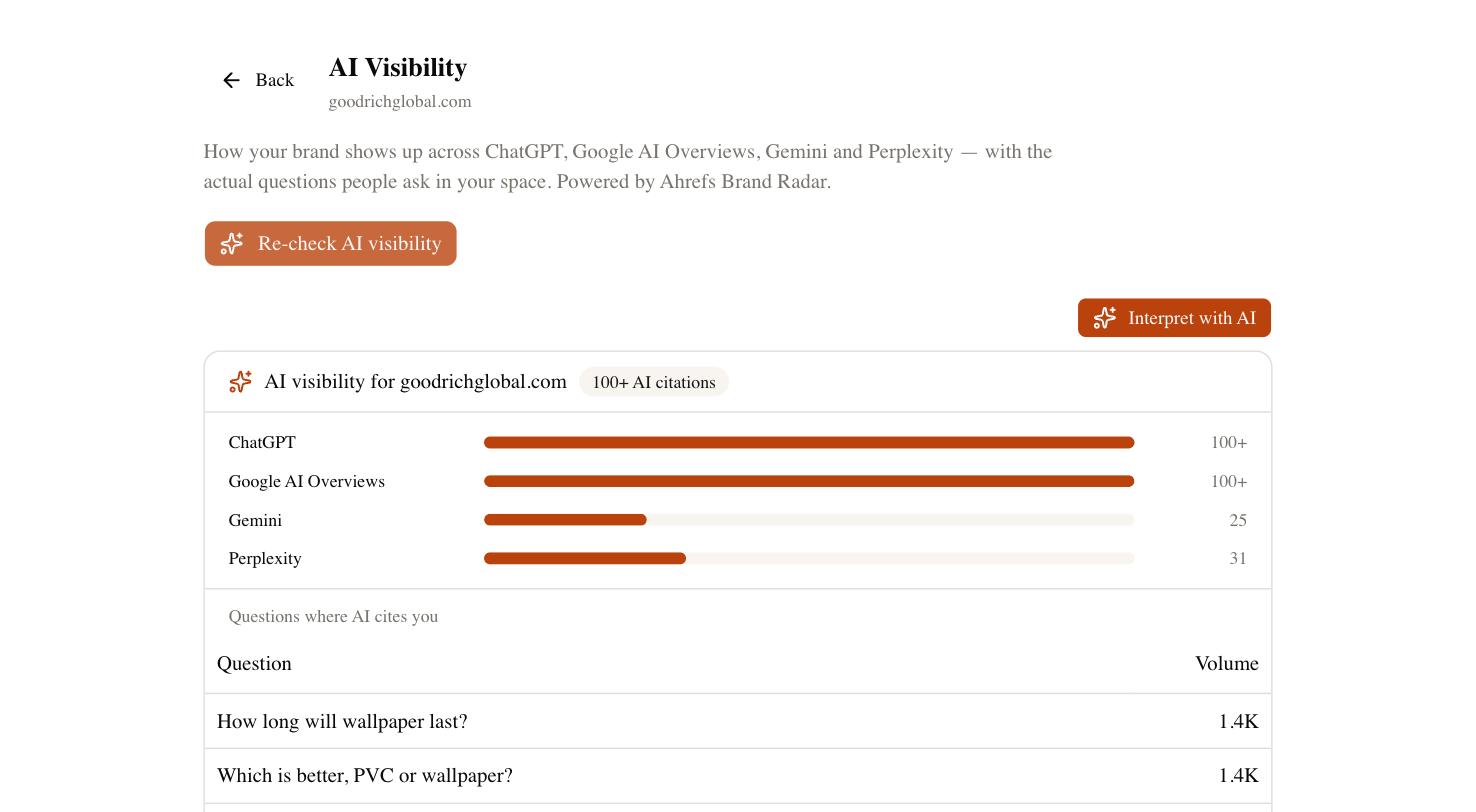
Around that, the rest of the workflow stays useful. Real Ahrefs-grade keyword and competitor-gap data tells you which questions are worth answering and which rivals already own the answer. The AI writing side drafts to the structure this niche rewards — answer-first, specific, extractable — instead of the padded long-form that used to win. And because it is one chat-first workflow rather than a stack of tabs, you can go from “what should I write” to “did it get cited” without exporting anything or paying for three separate subscriptions.
None of that replaces judgment. A tool can show you the gap and draft the page; it cannot decide what your audience actually needs to know. But it removes the two biggest blind spots — not knowing which questions matter and not knowing whether you were cited — and those two blind spots are where most AI-search effort quietly leaks away.
How to measure whether it’s working
Set the right yardstick or you will chase the wrong number. Ranking position still matters as a supporting signal, but the metric for this game is citation share: across the questions you care about, how often does an AI answer name you as a source? Track a set of real buyer questions, check them on a regular cadence, and watch the trend rather than any single result — remember answers vary run to run, so one absence is noise, a sustained absence is a problem.
Pair that with the boring fundamentals. If a page starts getting cited, protect it: keep the data current, keep the answer clean, and do not let a redesign bury the lead you worked to surface. Citations are earned and then defended, the same way rankings always were — just against a judge that reads instead of ranks.
Where to start this week
Pick your five highest-value questions — the ones a buyer asks right before they choose someone like you. Check today whether any AI engine cites you on them. For each miss, open the page that should have won and run it through the checklist above: answer up front, one quotable fact, full coverage, clean structure. Fix the weakest one first, republish, and check again in a couple of weeks.
That loop — find the gap, write the answer, confirm the citation — is the whole discipline. A content strategy for ai search is not exotic; it is disciplined answering, measured against the surfaces your customers actually use. Do it on five questions, prove it moves, then scale it. The teams winning here are not the ones publishing the most. They are the ones who write to be quoted and bother to check whether they were.