
SEO for franchises is really two jobs wearing one brand. You have to win local search for every individual location so customers near each store find it, and at the same time you have to rank nationally for the franchise-development terms that bring in new franchisees. Most franchise systems are good at one and blind to the other.
SEO for franchises also carries a structural problem no independent business faces: dozens or hundreds of near-identical location pages, all fighting over the same brand name, sometimes on the same domain and sometimes scattered across franchisee-owned sites. Get the architecture wrong and your locations compete with each other instead of with the pizza shop down the street.
Why franchise SEO is a different game
An independent plumber optimizes one website for one service area. A franchise brand has to make a single identity work across many markets while keeping each location genuinely findable in its own town. The buyer intent splits cleanly. A customer types “oil change near me” or “[brand] Tampa” and wants the closest open location. A prospective investor types “[brand] franchise cost” and wants a discovery page, financials, and an application form. Those two people should almost never land on the same URL.
That split is the whole strategy. Customer intent is local and high-volume. Investor intent is national, lower-volume, and far higher value per conversion. You run both tracks in parallel, and you measure them separately. Mixing them is the first mistake most brands make: they pile franchising pitches onto customer pages, or hide location finders behind investor copy, and both audiences bounce. Keep the two funnels on separate URLs, with separate calls to action, from the start.
The two keyword worlds you compete in
Before you touch a page, map the demand on both sides. Here is what the two intent buckets actually look like for a service franchise:
| Keyword example | Who’s searching | Intent | Target page |
|---|---|---|---|
| haircut near me | Local customer | Local commercial | Location page + Google Business Profile |
| [brand] Denver hours | Existing customer | Local navigational | Location page |
| best drain cleaning [city] | Local customer | Local commercial | Location + service page |
| [brand] franchise cost | Investor | National research | Franchise-development page |
| how to open a [brand] franchise | Investor | National research | Development guide / FAQ |
| most profitable franchises 2026 | Investor | Top-of-funnel | Blog / resource hub |
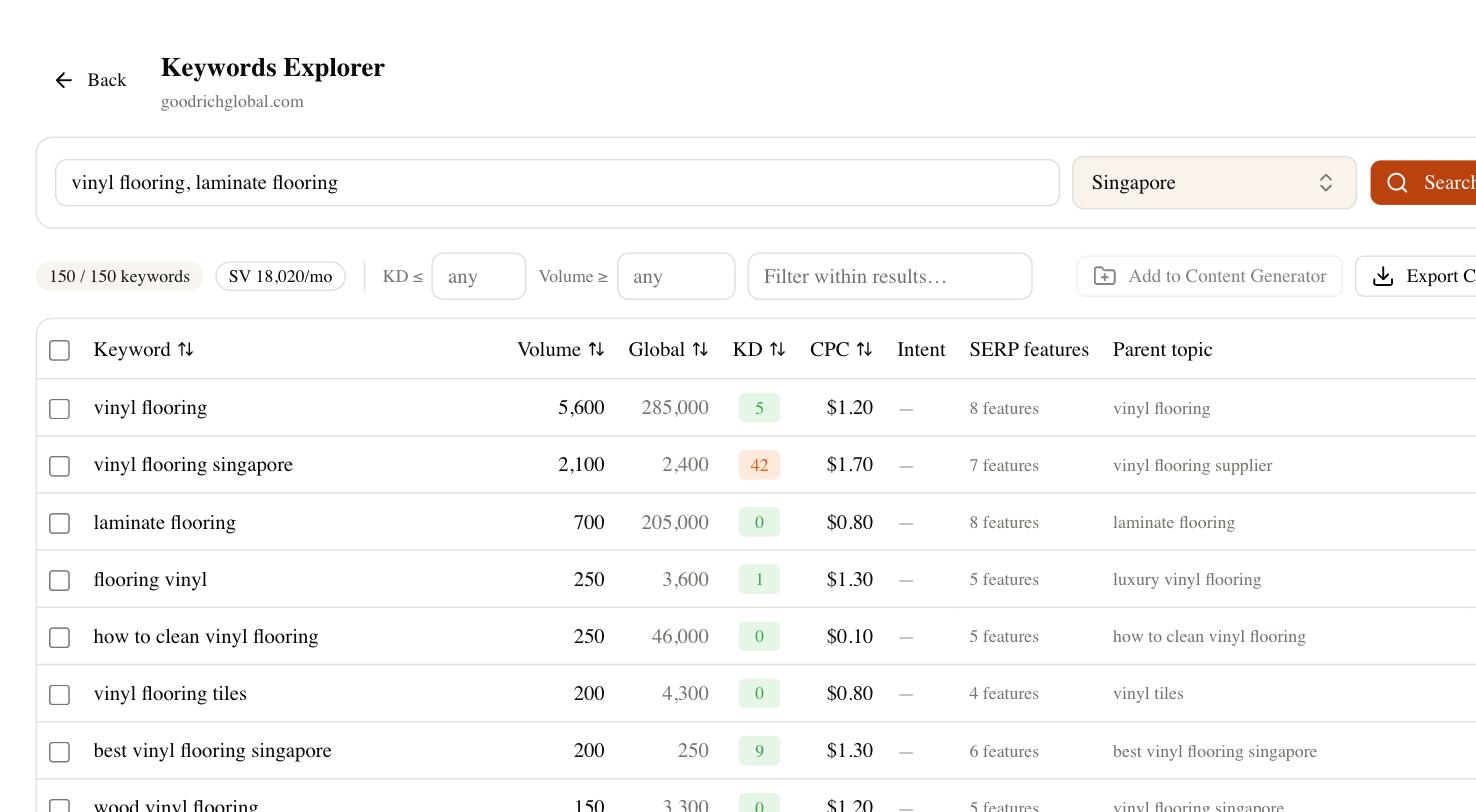
The near-me and city-plus-service terms are your bread and butter, and they repeat for every market you operate in. Multiply a dozen service keywords by fifty cities and you have a keyword pool no one can research by hand. The development terms are a small, stable set you can own with a handful of strong pages.
Win local search for every single location
Local rankings come from three things working together, and franchises break all three at scale. First, a claimed and complete Google Business Profile for each location, with accurate name, address, phone, hours, and categories. Second, a dedicated location page on your site with unique content — real staff, real photos, local landmarks, embedded map, and the services that specific store offers. Third, consistent citations: the same NAP data across every directory that mentions you.
The trap is templating. It is tempting to spin up one location page template and swap the city name, but a page that reads “Welcome to [brand] [City], the best in [City]” fifty times over is thin content that Google treats as near-duplicate. Each page needs a reason to exist. Write about the actual neighborhoods served, the parking, the local team. It is slower, and it is the difference between showing up in the local pack and disappearing.
Don’t let your locations cannibalize each other
Keyword cannibalization is the quiet killer in franchise SEO. When two location pages both target “[brand] pizza” without geographic qualifiers, Google can’t tell which to rank and often ranks neither well. The fix is disciplined geo-targeting: every location page owns its city and its city only, in the title tag, the H1, the URL, and the on-page copy.
Site architecture matters just as much. A single domain with clean /locations/city-name/ URLs almost always outperforms a scatter of franchisee-owned microsites, because all the authority compounds on one domain instead of being diluted across many weak ones. If your franchisees insist on their own sites, at minimum enforce a shared template standard and cross-link back to the parent. Fragmentation is the most expensive mistake a growing system makes.
Own the franchise-development keywords
The investor side is where the real revenue hides, and it is far less competitive than the customer side. A prospective franchisee researching “[brand] franchise cost,” “franchise opportunities [industry],” or “how much to open a [brand]” is worth thousands of times a single customer. Yet most brands bury this behind a single “Franchising” link and call it done.
Build it out properly. One strong development landing page targeting your brand-plus-franchise terms, a genuinely useful cost-and-fees breakdown, an FAQ that answers the real questions investors ask, and a few resource articles targeting category terms like “most profitable franchises” or “franchises under $100k.” This content ranks for months because the query volume is stable and the competition is a handful of brands doing the bare minimum. It is the highest-leverage content in the entire program.
The mistakes that sink franchise programs
Most franchise SEO problems come from a short, repeatable list. Work down it before you spend on anything else:
- Duplicate or templated location pages with no unique local content.
- Inconsistent NAP data across Google Business Profiles and directories.
- Location pages cannibalizing each other for un-geo-qualified brand terms.
- Franchisee microsites fragmenting domain authority instead of one strong site.
- No dedicated franchise-development pages — customer and investor intent mixed on one URL.
- Unclaimed or incomplete Google Business Profiles for newer locations.
- No process to add SEO for a location on day one, so new stores launch invisible.
None of these are exotic. They are the predictable result of scaling a website faster than anyone was assigned to own search. Fix them in order of leverage: architecture and cannibalization first, because they cap the ceiling on everything else, then profiles and citations, then content depth. You will usually see local pack movement within a ranking cycle or two once the duplicate-content and geo-targeting issues are cleared.
Where SEO Rocket fits
The reason franchise SEO gets neglected is volume — the work multiplies with every location, and manual research doesn’t scale. SEO Rocket is built for exactly that shape of problem. Ask it in plain language to pull local keyword ideas for a new market and it returns real volume and difficulty on Ahrefs-grade data, so you can build a location page brief in minutes instead of an afternoon. Its competitor-gap tool shows what the strongest local rival ranks for that you don’t, per city.
Rank tracking handles the many-locations reality without a spreadsheet, and the client-dashboard view lets a franchisor hand each franchisee a read-only report on their own market. The AI writing helps you produce genuinely distinct location pages at the volume franchises need, rather than templated filler. And because search is shifting, the Brand Radar feature tracks whether your brand gets cited when someone asks an AI assistant “what’s the best [service] near me” — a question more of your buyers now ask. Start with the mistakes checklist, fix the architecture, then scale the keyword work with tools built to keep up.