
SEO for manufacturers works differently from SEO for a local plumber or an e-commerce store, and treating it like either one is why so many industrial sites underperform. Your buyer isn’t impulse-shopping — they’re a procurement engineer, a plant manager, or an OEM sourcing agent running a slow, spec-driven evaluation that can take months and end in a request for quote. Good SEO for manufacturers means showing up at the exact moment that person is comparing capabilities, tolerances, and lead times, not when they’re idly browsing.
This guide covers how your buyers actually search, the keywords worth ranking for, the highest-leverage moves, the mistakes that quietly cost you RFQs, and where SEO Rocket fits into the work.
How industrial buyers actually search
Manufacturing search intent is unusually literal. Buyers search by material, process, spec, and part — “316L stainless steel tube fittings,” “custom injection molding manufacturer,” “aluminum die casting supplier,” “ISO 9001 CNC machining.” They rarely type your brand name because they don’t know you yet; they type the thing they need made. That’s good news, because it means every capability you have is a keyword someone is searching.
The second thing to understand is the journey. A buyer might read three or four of your pages, download a spec sheet, and disappear for six weeks before submitting an RFQ. There’s no add-to-cart moment to optimize. Instead you’re optimizing to be the shop that gets shortlisted, which means your content has to answer engineering questions — tolerances, certifications, material grades, minimum order quantities — that a generic marketing page skips entirely.
Search intent here also splits between two very different people. An engineer researches the technical feasibility of a part, while procurement compares suppliers on price, lead time, and reliability. The same account can send both to your site during one buying cycle, so the pages that convert are the ones that satisfy each without making either dig. Answer the engineer’s spec question and the buyer’s sourcing question on the same page, and you shorten the path to a quote.
The money keywords for manufacturers
Not all search volume is worth chasing. A manufacturer’s highest-value keywords are the ones with buying or sourcing intent, even when the volume looks small. A term like “medical grade silicone molding supplier” might get a fraction of the searches of “what is silicone molding,” but the person typing it is holding a purchase order. Here’s how the intent tiers usually break down.
| Example keyword | Intent | Priority |
|---|---|---|
| custom injection molding manufacturer | Sourcing — ready to shortlist | Highest |
| 316 stainless steel fittings supplier | Spec-driven purchase | Highest |
| CNC machining services near me | Local sourcing | High |
| aluminum extrusion manufacturer USA | National sourcing / reshoring | High |
| injection molding tolerances chart | Research — early stage | Medium |
| what is powder coating | Informational | Low |
Chase the top of that table first. The informational terms have their place for building topical authority, but a page ranking for “aluminum extrusion manufacturer USA” pays for itself in a way that a definition page never will. A useful rule of thumb: if a keyword names a process, material, spec, or the word “supplier” or “manufacturer,” it belongs on your priority list, because someone typing it is closer to a purchase order than to a research paper.
Local versus national intent
Manufacturers straddle a line most businesses don’t. You may serve customers nationwide, yet a meaningful share of buyers still add “near me” or a city — “sheet metal fabrication Houston” — because freight cost and factory visits matter for heavy or custom work. Ignore local signals and you lose those buyers; over-index on local and you cap your reach.
The practical answer is to do both deliberately. Build capability pages that can rank nationally, and add a properly optimized Google Business Profile plus location content for the regions where proximity actually influences the buy. If you have multiple plants, each one deserves its own page with its own equipment list and certifications.
Reshoring has made national intent more valuable than it used to be. Terms like “made in USA” and “domestic supplier” now carry real sourcing weight as companies pull supply chains closer to home, and manufacturers who name their location and country prominently pick up buyers actively filtering for it. That’s a signal worth stating plainly on your capability pages rather than assuming visitors will infer it.
The highest-leverage moves
Most manufacturing sites are brochures — a home page, an “About Us,” a single “Products” page, and a contact form. That structure buries everything you could rank for. The single biggest win is usually to split capabilities into individual, deep pages: one for each process, material, or industry you serve.
A dedicated page for “medical device machining” that names your tolerances, cleanroom class, materials, and certifications will outrank a paragraph on a catch-all services page every time. Do that across your real capabilities and you turn one thin site into dozens of pages, each aimed at a specific sourcing search.
Two more moves compound fast. First, get your specs out of PDFs and into on-page HTML — Google indexes text far more reliably than it parses a spec sheet locked in a download. Second, earn links the way manufacturers actually can: supplier directories, industry associations, trade publications, and the case studies your customers publish about projects you delivered.
Common mistakes manufacturers make
The errors repeat from shop to shop, and most are fixable in an afternoon of planning.
- One page for everything. A single “Capabilities” page can’t rank for ten different processes. Split it.
- Specs trapped in PDFs. If your tolerances and materials live only inside downloads, search engines struggle to read them and buyers can’t find them.
- Vanity keywords over sourcing keywords. Ranking for a broad industry term feels good but rarely fills the RFQ inbox.
- No proof. Certifications, equipment lists, and real project photos are ranking and conversion signals at once — buyers and Google both want them.
- Ignoring AI search. More engineers now ask ChatGPT or Perplexity for supplier shortlists, and if you’re invisible there you’re missing a channel entirely.
None of these require a rebuild. They require deciding that your website is a sales tool for a technical buyer, not a digital business card.
Where SEO Rocket fits
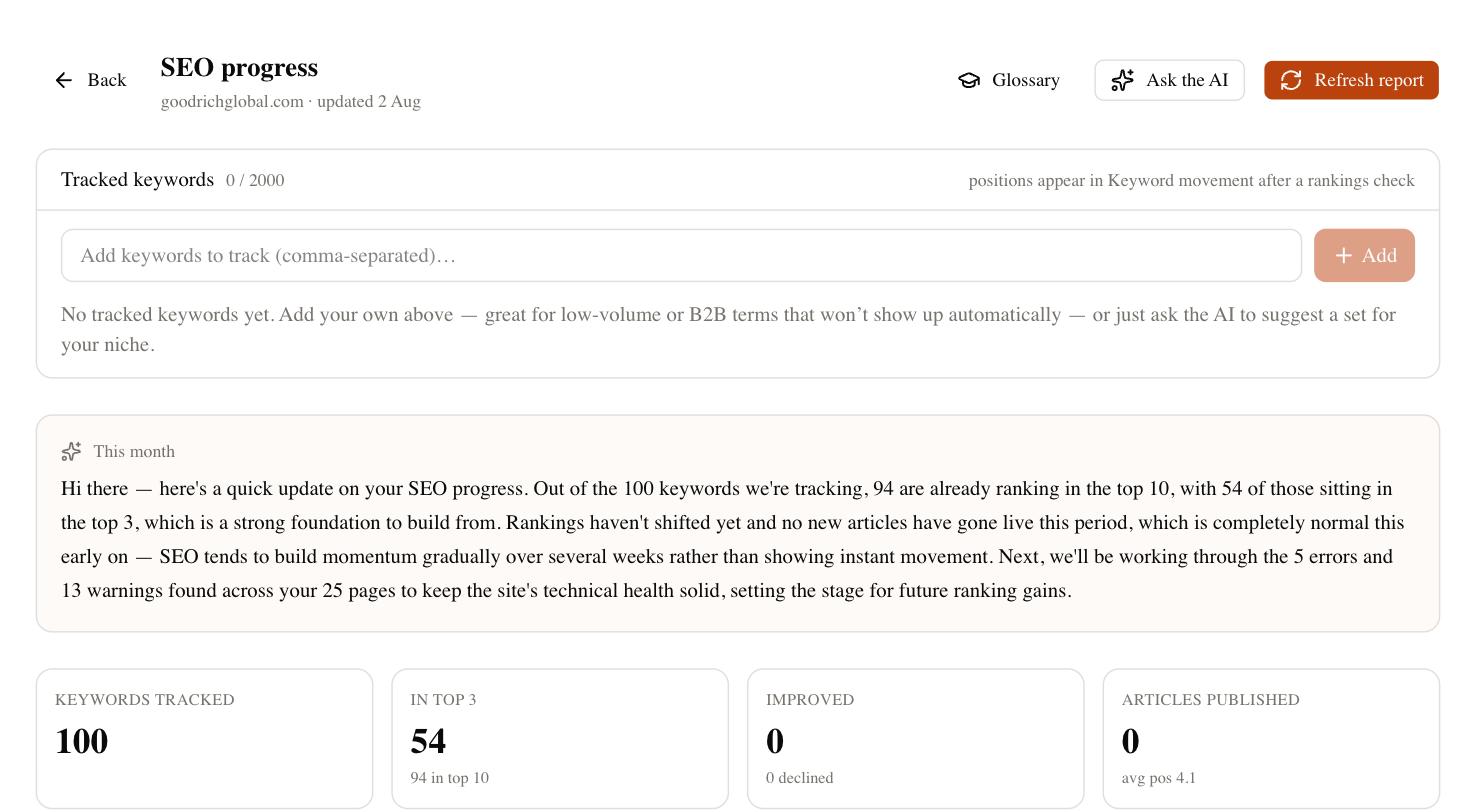
The work above is straightforward to describe and tedious to do by hand, which is where the tooling helps. In SEO Rocket you can ask in plain language for the sourcing keywords in your niche and get real, Ahrefs-grade volume and difficulty back — so you build capability pages around terms buyers actually type, not guesses. The competitor gap view shows which processes rival shops rank for that you don’t, which is often the fastest capability-page roadmap you’ll find.
From there, rank tracking watches your priority terms week to week, the site audit flags the thin pages and PDF-only content holding you back, and the client dashboard gives agencies a clean read-only report to hand a manufacturing client. Brand Radar covers the newer question — whether AI search engines name you when someone asks for a supplier. Expect a full ranking cycle before you judge results; industrial terms move slowly, but the buyers they bring are worth the wait.