SEO for online courses fails in a predictable way: you build a beautiful course page, target “buy [topic] course,” and then wonder why the traffic never comes. The problem is that almost nobody types “buy” into Google. SEO for online courses works when you meet learners far earlier — while they are still deciding whether the skill is worth learning at all — and carry them to enrollment from there.
This guide covers what makes this niche different, the exact searches your buyers run, the moves with the most leverage, the mistakes that quietly bleed enrollments, and how the right tools shorten the whole process.
Why this niche behaves differently
Course buyers do not search like ecommerce shoppers. Someone buying a product knows what they want and compares options. A prospective learner usually does not — they have a problem (“I keep getting passed over for promotions”) long before they have a solution (“I need a project management certification”). That gap is your entire funnel.
Two other things set this niche apart. First, your competitors are not only other course sellers; they are free content on YouTube, Coursera, and Reddit, so a page that just describes your curriculum rarely wins. Second, intent splits sharply by whether the skill leads to a credential. “Learn watercolor painting” is pure curiosity and global. “NASM personal trainer certification” is high commercial intent, and some course categories — real estate licensing, bookkeeping, TEFL — carry country- or state-specific rules that make certain queries genuinely local.
The practical takeaway is that you are running two motions at once. One chases broad, informational demand that may never mention a course; the other chases a smaller, hotter set of buyers ready to enroll. Treat them as one strategy and you either write generic advice that never sells or sales pages nobody finds. Separate them deliberately and each does the job it is good at.
The searches your buyers actually run
Map your keywords to the stage of the decision, not to your product catalog. Here is how the intent typically breaks down for a course business.
| Example query | Stage | What they want |
|---|---|---|
| how to become a UX designer | Problem-aware | A path, not a product |
| is a data analytics certificate worth it | Evaluating | Reassurance the skill pays off |
| best online course for python | Comparing | A shortlist to choose from |
| google data analytics vs coursera | Comparing | A head-to-head verdict |
| [your brand] course review | Deciding | Proof before they pay |
| PMP certification online | Ready to buy | An accredited program now |
Notice that only the last two rows are “money” keywords in the obvious sense — yet the top rows carry far more volume and shape which brand the buyer eventually trusts. Skip them and you are fighting for the small pool of already-decided searchers, against everyone else who also ignored the top of the funnel.
Win the top of the funnel first
Your highest-leverage move is publishing genuinely useful content for problem-aware searchers, then guiding them toward the course. A “how to become a bookkeeper” guide that honestly lays out the steps, the timeline, and the salary range earns the reader’s trust — and a natural, non-pushy mention of your certification at the point where they realize they need one converts far better than any landing page.
Build these in clusters. One pillar page for the career or skill, supported by articles answering the questions around it: cost, timeline, prerequisites, job outcomes, “is it worth it.” Internally link them so the cluster reinforces itself and search engines see you as the authority on that topic, not just a vendor with one page to sell.
Do not undersell this content because it does not scream “buy now.” A reader who finishes your honest guide to becoming a bookkeeper has spent five minutes learning to trust you, and trust is the thing that converts at the enrollment page later. The course sites that win the money keywords almost always won the informational ones first.
Then capture credential and comparison intent
Closer to the money, two query types convert hardest. Credential searches — “[skill] certification online,” “accredited [skill] course” — are buyers with a wallet open, so give each a dedicated page with the accreditation named plainly, the syllabus, and the outcome. Where the credential is jurisdiction-specific, create location pages (“real estate license course California”) rather than one vague national page, because those searchers will not trust a page that ignores their state’s rules.
Comparison and review queries are the other half. Learners almost always search “[your course] review” and “[competitor] vs [competitor]” before paying. If you leave that page for someone else to write, an affiliate site captures your buyer at the last step. Publish honest comparisons that concede where a rival suits certain people better — that candor is exactly what makes the recommendation credible when it lands on you.
One caution: these pages age. Curricula change, prices move, and a review that is two years stale reads as neglect. Put a refresh date on them and revisit each one at least once a year so the page a buyer trusts is actually current.
Mistakes online course sites keep making
The same errors show up on course site after course site. Fixing even two of these usually moves the needle faster than chasing new keywords.
- Only targeting bottom-funnel terms. Betting everything on “buy” and “enroll” keywords ignores the far larger audience still deciding whether to learn the skill.
- Thin course pages. A title, a price, and a “sign up” button cannot outrank a 2,000-word guide. Course pages need real depth: curriculum, instructor credibility, outcomes, and FAQs.
- Skipping Course structured data. Course schema can surface your rating, provider, and price directly in results. Many course sites never add it and lose the visual edge.
- Duplicate boilerplate across course pages. Fifty courses that share the same templated paragraph read as thin, near-duplicate content and suppress the whole set.
- Ignoring AI search. More learners now ask ChatGPT “what’s the best way to learn X” and never see a Google result at all.
Where SEO Rocket fits
The tooling exists to make this concrete rather than guesswork. Start with the gap: your established competitors already rank for hundreds of the problem-aware and comparison queries above, and the fastest way to a content plan is to see exactly which ones you are missing.
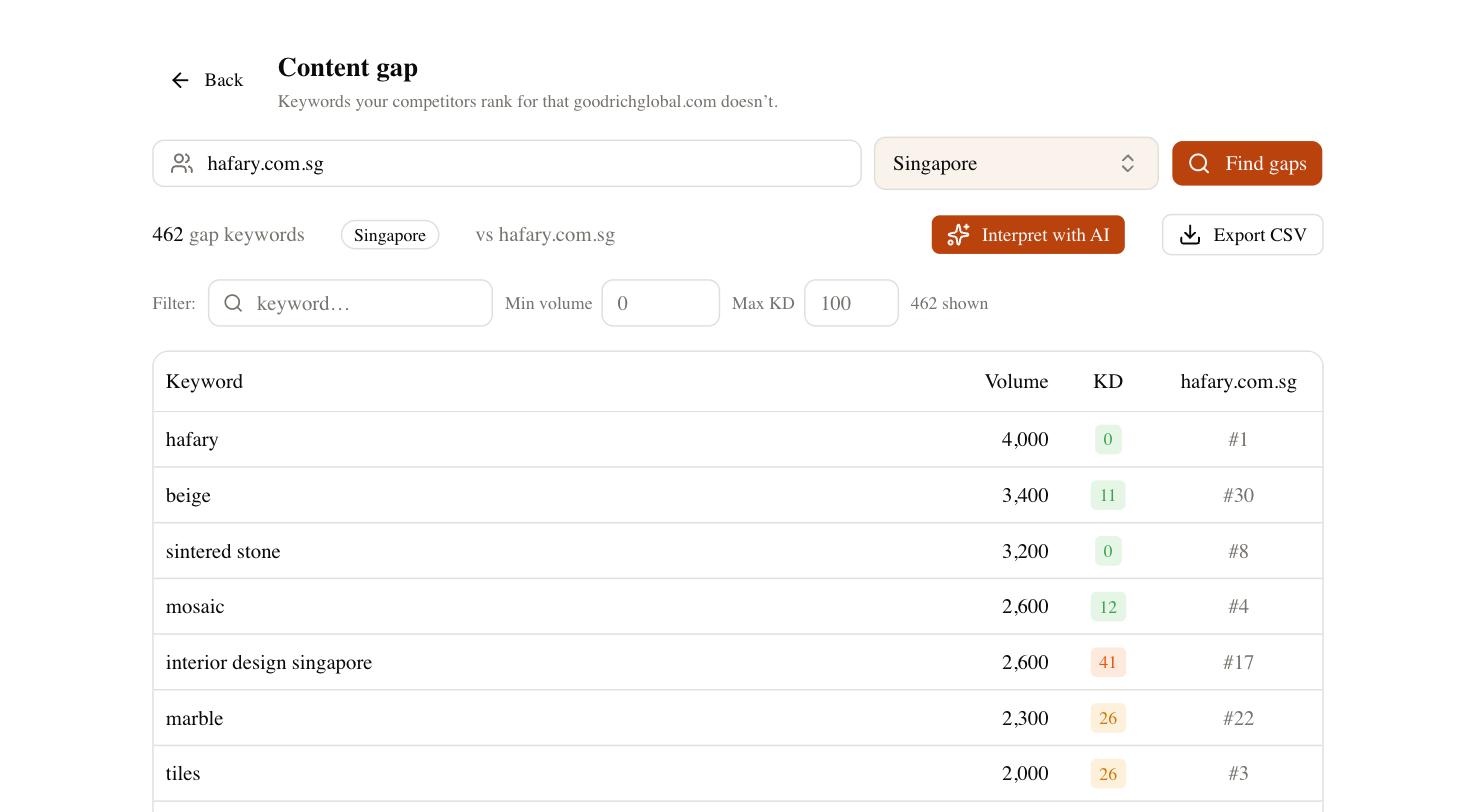
From there the pieces connect. Keyword research sizes each topic and its difficulty so you prioritize winnable clusters over vanity terms. The AI writer drafts the pillar-and-cluster content on real data instead of a blank page. Rank tracking watches your credential and comparison pages over a full cycle, so you judge them on trend rather than daily jitter. Brand Radar answers the question no rank tracker can: whether ChatGPT and Perplexity name your course when someone asks how to learn the skill. And if you run courses for clients or partners, the dashboards hand each one a read-only view without exporting a thing.
A priority checklist to start this week
You do not need to do everything at once. Work down this list in order and you will feel the difference within a ranking cycle or two.
- List your three highest-margin courses and the credential or skill each teaches.
- Run a content gap against two competitors and pull the problem-aware queries you are missing.
- Publish one honest pillar guide per priority course, linking to the course at the point of need.
- Add or rewrite a dedicated review page and one real comparison for each course.
- Fatten thin course pages and add Course structured data to every one.
- Set up rank tracking and check whether AI answers ever mention you.
Done in that order, SEO for a course business stops being a gamble on a handful of “buy” keywords and becomes a system that meets learners where they actually start. Give it a couple of months, measure on trend rather than day-to-day movement, and let the top of the funnel do the selling the bottom of it never could.