
SEO for mortgage brokers is not the same job as SEO for a national ecommerce brand, and treating it like one is why so many broker sites quietly stall. Done right, SEO for mortgage brokers is mostly a local game — you are competing to be the specific, licensed broker a borrower in one metro finds the week they decide to buy or refinance.
That distinction changes almost every decision you make: which keywords to chase, how many pages to build, and where you put your first ten hours of effort. This guide walks through how mortgage borrowers actually search, the keywords that turn into applications, the highest-leverage moves, the mistakes that waste months, and where the right tools save you the busywork.
How mortgage borrowers actually search
Mortgage search is event-driven, not casual. Nobody researches loan terms for fun — they search because something happened: a lease is ending, a rate dropped, a family is outgrowing a condo, or a fixed period is about to reset. That means your traffic spikes around life events and rate movements, and your job is to be present at the exact moment intent turns into an inquiry.
It is also intensely local and license-bound. A broker licensed in Texas cannot help a buyer in Ohio, so ranking nationally for “mortgage rates” is a vanity metric that sends unqualified clicks. The searches that matter carry a place or a loan program attached — “mortgage broker in Austin,” “FHA loan broker near me,” “jumbo loan refinance Denver.” Winning a handful of those beats ranking page two for a head term with fifty times the volume and none of the reach. Match your effort to the map you are actually licensed to serve, and every ranking you earn becomes a real conversation rather than a wasted click from a state you cannot help.
The money keywords worth targeting
Keywords for brokers fall into a few clear buckets, and each one signals a different stage of readiness. The most valuable are the ones where someone is ready to talk to a human: “near me” searches, city-plus-service phrases, and specific loan programs. Informational queries still matter — they build trust and feed AI answers — but they convert slowly, so they should support your money pages, not replace them.
| Example keyword | Intent | Priority |
|---|---|---|
| mortgage broker near me | Ready to contact — highest value | High |
| mortgage broker [your city] | Local commercial | High |
| first time home buyer loans [city] | Program + local commercial | High |
| FHA / VA / jumbo loan broker | Program-specific, high intent | High |
| refinance rates [city] | Rate-driven, time-sensitive | Medium |
| self-employed mortgage options | Niche qualifier, low competition | Medium |
| how much house can I afford | Early research, trust-building | Low |
| what is a mortgage broker | Informational, feeds AI answers | Low |
Notice the pattern: the highest-priority terms all pair a place or a program with clear commercial intent. Those are the pages worth building carefully. The lower-priority informational terms belong in a blog or FAQ that quietly earns links and answers the questions a nervous first-time buyer types at 11pm.
The highest-leverage moves
If you only do a few things, do these. First, your Google Business Profile is often more powerful than your website for local searches — complete it fully, keep hours and service areas accurate, and treat reviews as a ranking factor, not a vanity badge. A steady drip of recent, detailed reviews moves the local pack more reliably than most on-page tweaks.
Second, build a real page for each core loan program and each city or neighborhood you serve, and make each one genuinely useful — local down-payment programs, typical closing timelines, the documents you will ask for. A page that says “we offer FHA loans in Austin” and nothing else will not rank; a page that actually explains the Austin FHA process will. Third, earn local relevance signals: get listed with the local Realtor associations, sponsor a first-time-buyer workshop, and win a mention from a partner agent’s site. In a licensed, trust-heavy vertical, a few authoritative local links outperform a pile of generic ones.
Common mistakes mortgage brokers make
The biggest one is chasing national head terms. Ranking for “best mortgage rates” feels like progress, but it fills your calendar with out-of-state tire-kickers you cannot serve. The second is thin, near-duplicate city pages — spinning up forty “mortgage broker in [city]” pages with the city name swapped in is a spam pattern search engines catch, and it drags down the whole domain.
Two more come up constantly. Brokers ignore reviews until a bad one appears, then panic — the fix is a simple, consistent request at closing, every time. And most never check whether they show up in AI answers at all. A growing share of borrowers now ask ChatGPT or Google’s AI Overviews “who’s a good mortgage broker in my area,” and a page that ranks fifth in classic search can be completely absent from that answer. If you are not measuring it, you cannot fix it.
Where SEO Rocket fits
Good seo for mortgage brokers is mostly execution and measurement, which is where a chat-first tool earns its keep. In SEO Rocket you ask for what you need in plain language: pull the real search volume and difficulty for “refinance rates” across your target cities, see which loan-program pages a competing broker ranks for that you don’t, and track your positions on the local terms that actually convert. The data underneath is Ahrefs-grade, so the numbers hold up.
Two features matter especially here. Brand Radar tracks whether you are being cited in AI search — ChatGPT, Perplexity, and AI Overviews — so you can see the AI-answer gap most brokers never even look at. And when you spot a missing loan-program page, the AI writer drafts it on the same data, grounded in your service area rather than generic filler.
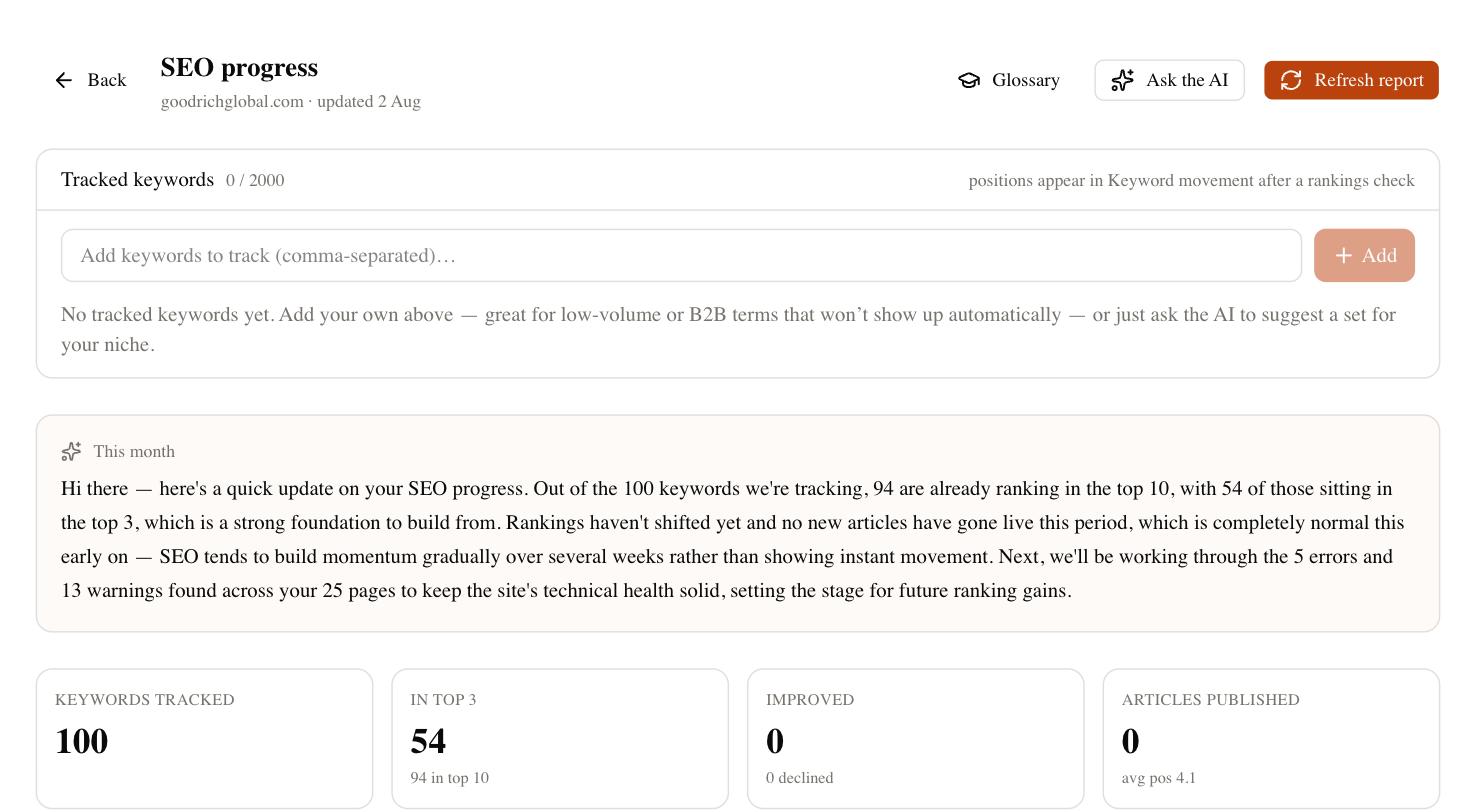
The client dashboard side is a bonus if you work with partner agents or report to a broker-owner. You can hand over a read-only, white-label view of rankings and progress without exporting spreadsheets, which keeps referral partners confident that the SEO work is moving.
A priority checklist to start this week
Do not try to do everything at once. Work down this list in order — each step compounds on the one before it.
- Claim and fully complete your Google Business Profile, with accurate service areas.
- Set a review request into your closing workflow so it happens every time, automatically.
- List your five highest-intent keywords — the city and loan-program terms — and confirm real volume before building.
- Build or rewrite one strong page per core loan program, with genuine local detail.
- Add city or neighborhood pages only where you truly serve and can write something unique.
- Earn two or three local, relevant links from agents, associations, or community sponsorships.
- Check whether AI answers mention you, and track it monthly.
None of this is fast — local SEO typically takes a few months to show, and rankings jitter a little day to day, so judge progress over weeks, not mornings. But the brokers who win their metro are rarely the ones with the biggest budgets. They are the ones who picked the right five keywords, built pages worth ranking, and kept the reviews coming while everyone else chased national head terms. Start there, measure honestly, and let the compounding do the rest.