SEO for marketing agencies is a strange discipline, because you sell the service and yet your own site is usually the last one you ever optimize. The cobbler’s children go barefoot, and SEO for marketing agencies tends to lose to billable client work every single week.
That is a costly habit. When a prospect finds you through search, they have already decided they need help and they are comparing three or four names. Ranking for the right queries is not vanity — it is a warm inbound lead who trusts you more because they found you, not because you cold-emailed them. This guide covers what makes search different for your niche specifically: how buyers hunt for agencies, which keywords actually pay, and where to spend your limited hours.
How your buyers actually search for an agency
The person hiring an agency is rarely typing “marketing agency” on its own. That head term is a mix of students, job seekers, and people researching the industry — almost no buyer intent. Real prospects add qualifiers: a service (“PPC agency,” “SEO agency,” “social media marketing agency”), a location (“marketing agency Austin”), an industry (“SaaS marketing agency,” “healthcare marketing agency”), or a company stage (“marketing agency for startups”).
Those qualifiers are the whole game. A search for “B2B marketing agency for manufacturers” has almost no volume and enormous intent — the handful of people typing it are ready to sign a retainer. Your job is to map the specific, low-volume, high-intent phrases your ideal client uses, then own them. Broad reach matters far less than being the obvious answer to a narrow question. One qualified page that ranks for a phrase your perfect client types can be worth more than a blog that pulls thousands of curious visitors who will never hire anyone.
The money keywords, and what they mean
Group your targets by intent before you write a single page. A high-volume term you can’t convert is worth less than a niche phrase a buyer types with a credit card open. Here is how the main buckets break down for an agency.
| Keyword example | Intent | Priority |
|---|---|---|
| digital marketing agency [city] | Local commercial — buyer wants someone nearby | High |
| SaaS marketing agency | Niche commercial — specialist buyer, high value | High |
| best marketing agency for startups | Comparison — buyer building a shortlist | High |
| PPC agency vs in-house | Consideration — buyer weighing options | Medium |
| how much does a marketing agency cost | Research — pre-buyer, capture the email | Medium |
| marketing agency | Head term — mostly non-buyers | Low |
The pattern is clear: service-plus-location and service-plus-niche pages win business, comparison and cost pages build trust with people who aren’t ready yet, and the naked head term is a trophy you rarely need. Chase the phrases that end in a phone call.
Local versus national — pick one battle
Most agencies waste months fighting the wrong fight. If you serve clients face to face or your pitch leans on being “your local team,” you are in a local game: Google Business Profile, “[service] agency [city]” pages, real reviews, and consistent name-address-phone details across directories. The local pack and “near me” results are where you’ll be chosen.
If you’re a specialist — a Shopify agency, a fintech PR shop, a demand-gen studio — location barely matters and you should go national on your niche. Clients will hire a great SaaS agency two time zones away without blinking. Trying to do both at once splits your content and your links, and you end up mediocre at each. Decide which describes you, and let that choose your keywords.
The highest-leverage moves
A few things move the needle far more than the rest. Build a dedicated page for each core service and each niche you serve, written to answer that buyer’s exact question rather than to list features. Turn your best results into case studies — they rank for “[industry] marketing results” style searches and they close deals, so they do double duty. Publish honest comparison and pricing content, because prospects are already searching it and you’d rather they read your framing than a competitor’s.
Then earn links the way an agency naturally can: original data from your campaigns, guest articles in industry publications, podcast appearances, and being quoted as a source. You produce marketing content for clients all day — point a fraction of that muscle at your own domain and you’ll outpace agencies that only ever bill it out. A single quarter of consistent, self-directed effort usually puts an agency ahead of rivals who have neglected their own site for years.
Mistakes marketing agencies keep making
The biggest one is neglect: treating your own site as a portfolio brochure that hasn’t changed in two years. Close behind is chasing that vanity head term instead of the qualified long-tail phrases that convert. Thin location pages are another trap — spinning up twenty near-identical “[city]” pages with the city name swapped in gets you filtered, not ranked, so build only the locations you genuinely serve and make each one specific.
Two more worth naming. Agencies routinely bury their case studies in a hard-to-crawl portfolio widget, wasting their strongest ranking and converting asset. And many now ignore AI search entirely — buyers increasingly ask ChatGPT or Perplexity “who’s the best agency for X,” and if you’re invisible there, you’re losing shortlist spots you never see.
Where SEO Rocket fits
Doing all of this by hand across a dozen tools is why it never gets done. SEO Rocket is chat-first: you ask for keyword research, competitor gaps, or a rank-tracking update in plain language and it runs the lookup on real, Ahrefs-grade data. Point the competitor gap at two rival agencies and you’ll see the exact service-and-niche queries they rank for and you don’t — your content roadmap, handed to you. Brand Radar tracks whether you’re being cited in AI answers, so you can tell if you show up when a buyer asks an assistant for a recommendation.
The other half matters if you also deliver SEO to clients. You can draft service pages and case-study articles with built-in AI writing, run a site audit before a pitch, and hand each client a read-only, white-label dashboard instead of a monthly PDF nobody reads.
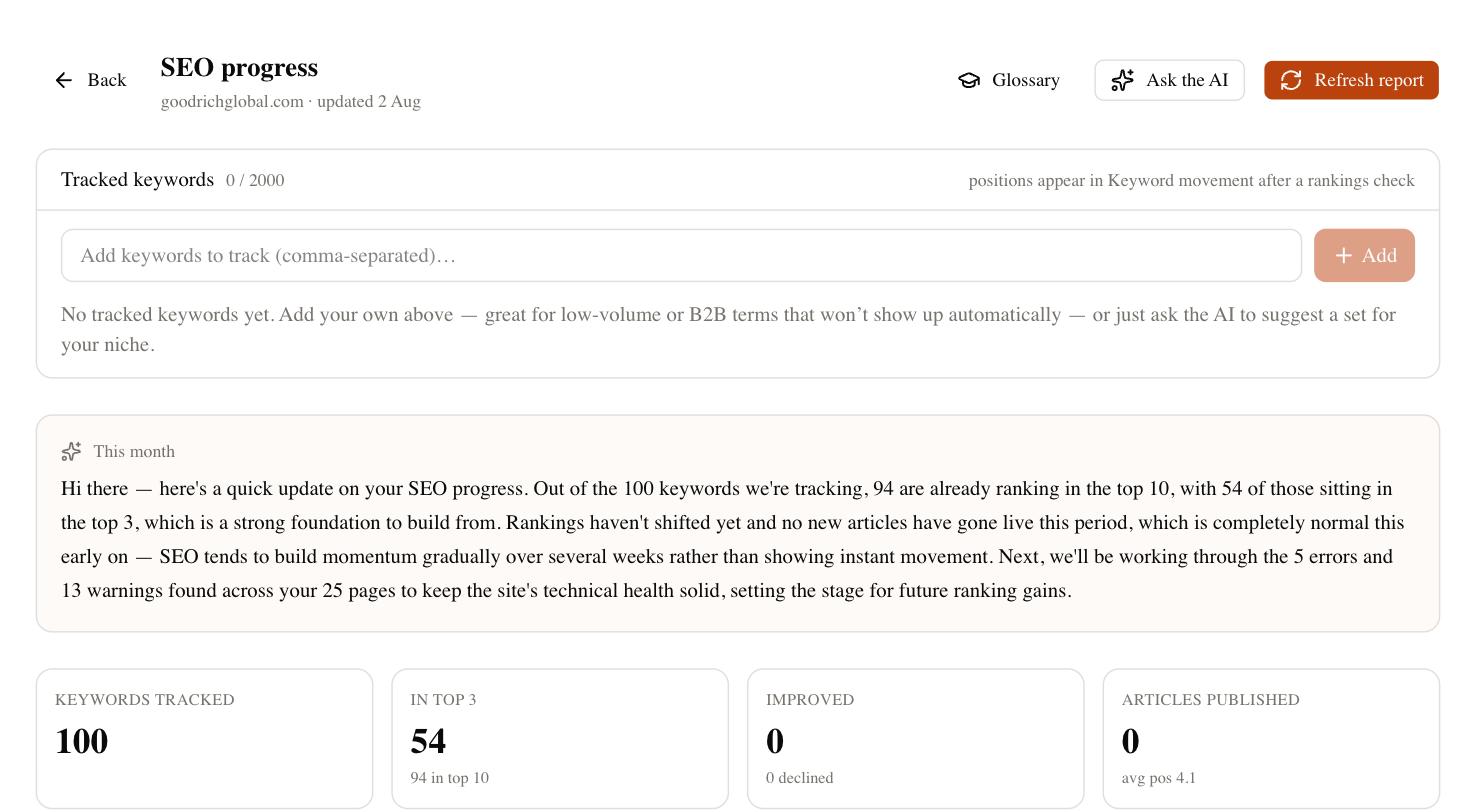
That client-facing side is a quiet advantage: proving results in a clean live report keeps retainers alive, and it demonstrates competence to the exact buyers who are also Googling you.
A priority checklist to start this week
You don’t need a six-month plan to start. Work down this list in order and you’ll cover the moves that matter most.
- Fix positioning first — decide local or national, and one to three niches you truly serve.
- Build the money pages — one strong page per core service and per niche, written for the buyer.
- Surface your case studies — make them crawlable, specific, and easy to find.
- Claim and optimize Google Business Profile if you’re playing the local game.
- Run a competitor gap against two rival agencies and steal their winning queries.
- Track your AI visibility — know whether assistants name you when buyers ask.
None of this is quick, and rankings will jitter a few spots day to day before they settle. But an agency that finally practices what it sells builds the most convincing case study it will ever own — its own front page.