
SEO for jewelry stores is not the same job as ranking a plumber or a SaaS blog, and treating it that way is why most jewelry sites stall on page three. Your buyers are making a rare, high-consideration, emotionally loaded purchase — an engagement ring, an anniversary gift, an heirloom repair — and they research for weeks before they ever walk in or check out. Good SEO for jewelry stores meets them at every step of that long path, not just at the final “buy now” moment.
The upside is that jewelry keywords carry real commercial weight. Someone typing “custom engagement ring” or “watch repair near me” is close to spending real money, and there are far fewer of those searchers than there are ranking pages fighting for tire-kickers. Win the right terms and a single position gain can be worth thousands in margin.
Why jewelry search behavior is different
Two things set this niche apart. First, the buying cycle is long and split across many query types: your customer starts with education (“lab grown vs natural diamond”), moves to consideration (“1 carat diamond ring price”), then to intent (“engagement rings Austin”), and finally to your brand name. You need content for each stage, because whoever teaches the buyer early tends to close them later.
Second, jewelry is unusually visual and trust-heavy. People will not drop $4,000 on a ring from a site that looks thin or anonymous. That means your images, reviews, return policy, certifications, and craftsmanship story are not fluff — they are ranking and conversion factors working together. Google reads the same trust signals your buyer does.
There is also a seasonality most stores underplan for. Engagement searches spike from November through February around the holidays and Valentine’s Day, and Mother’s Day drives a second gift wave in spring. Content published two months ahead has time to earn rankings before the demand arrives, so your editorial calendar should run a season early rather than reacting to it.
The searches your buyers actually make
Do not guess at keywords. Group them by intent, because each group needs a different page. Here is the pattern that repeats across nearly every jewelry store:
| Keyword example | Intent | Page it deserves |
|---|---|---|
| engagement rings [your city] | Local commercial | Local landing / category page |
| custom engagement ring | High-intent service | Dedicated custom-design service page |
| jeweler near me | Local navigational | Google Business Profile + homepage |
| watch repair near me | Local service | Repair service page |
| lab grown diamond rings | Product consideration | Collection page + buying guide |
| how much should an engagement ring cost | Informational | Blog / guide article |
| ring resizing cost | Informational service | Repair FAQ or service page |
| eternity band vs wedding band | Comparison | Guide article |
Notice how few of these are answered by a generic homepage. The stores that win build a page for each intent cluster instead of hoping one product grid ranks for everything.
Local intent is where the money hides
Unless you ship nationally, most of your revenue-driving terms are local: “[city] jewelry store,” “engagement rings [city],” “jewelry repair [neighborhood].” These are less competitive than the national head terms and convert far better, because the searcher already intends to visit a shop.
Your highest-leverage local move is your Google Business Profile. Get the category exact (“Jewelry store,” “Jeweler,” “Watch repair service”), keep hours and photos current, and earn steady reviews — reviews are the single biggest lever on map-pack rankings for this category. Back that up with city-specific landing pages that mention real neighborhoods, parking, and appointment booking, not just a swapped-in city name. National-only content is a fine layer on top, but for a store with a showroom, local is the foundation.
If you run more than one location, resist the temptation to point every branch at the same page. Each showroom needs its own address, its own profile, and its own landing page, or they compete with each other and dilute the local signals you are trying to build. The stores that dominate a metro treat every location as a small site of its own.
Product and collection pages that actually rank
Most jewelry sites lean on a platform theme and ship product pages that are nearly identical: a title, a price, three specs. That is thin content, and thin content loses even when everything else is right. Fix it where it counts. Write genuine descriptions for your top collections, add buying guidance (“how to choose a setting”), and use unique alt text on every image — your photos are prime real estate that most competitors leave blank.
Add product schema markup so rich results can show price, availability, and review stars in the search listing. For your service pages — repair, appraisal, custom design — spell out what is included, rough turnaround times, and what affects cost. You do not need to publish exact prices, but a buyer who understands the process trusts you enough to call.
Do not delete pages for pieces that sell out, either. A discontinued ring often keeps earning links and rankings, so redirect it to the closest live collection rather than letting it return a dead 404. Small housekeeping like this compounds over a catalog that turns over constantly.
The mistakes jewelry stores keep making
The same handful of errors quietly cap growth for store after store. Watch for these:
- One page for everything. Trying to rank the homepage for engagement rings, repair, and custom work at once. Split them.
- Ignoring reviews. Treating reviews as reputation management instead of the ranking factor they are for local search.
- Empty alt text and slow images. High-resolution jewelry photos are essential, but uncompressed files tank your page speed and your mobile rankings.
- No informational content. Skipping the buying guides that capture people three weeks before they purchase, then wondering why only bottom-funnel traffic converts.
- Chasing national head terms. Burning months on “engagement rings” nationally when “engagement rings [city]” is winnable now.
None of these are hard to fix. They persist because most stores never audit which pages compete with each other or which keywords their competitors already own.
Where SEO Rocket fits your workflow
This is where a tool earns its keep. Instead of guessing, you can ask SEO Rocket in plain language which local jewelry terms you rank for, which ones a nearby competitor owns that you do not, and where a small content push would pay off fastest. It runs on Ahrefs-grade data, so the volume and difficulty numbers are real, not invented.
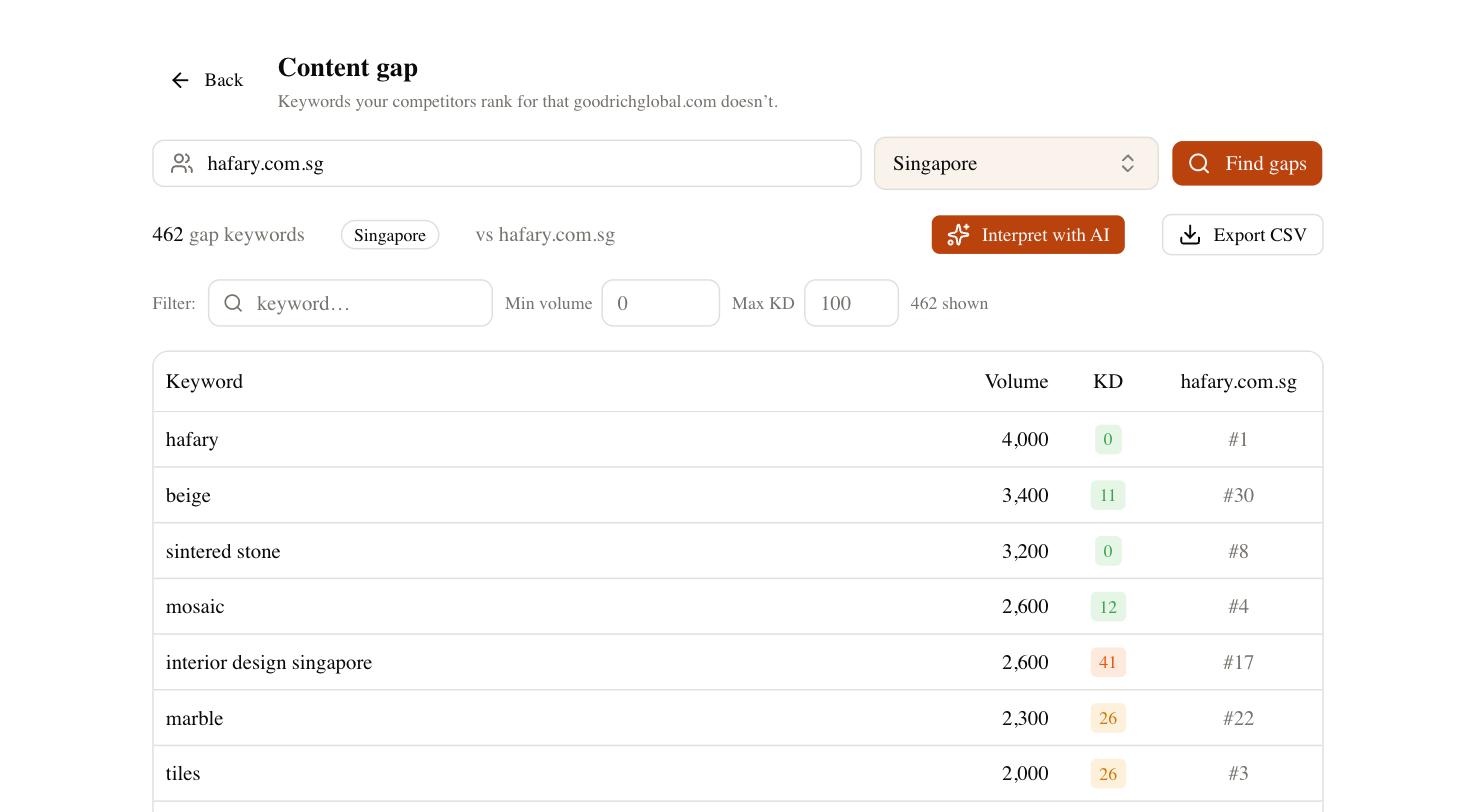
The content-gap view is especially useful for jewelry, because your competitors have usually already built the buying guides and collection pages you are missing. From there, the same tool drafts the article, tracks whether your local rankings actually move week to week, and — increasingly important — shows whether ChatGPT and Google’s AI Overviews mention your store when someone asks for a jeweler in your city. That last surface is new, and most local competitors are not watching it yet.
Your priority checklist
If you do nothing else, work this list in order. Each step builds on the last:
- Claim and fully complete your Google Business Profile, then set up a steady review request routine.
- Build one page per intent: local category, custom design, repair, and your top product collections.
- Add unique descriptions, compressed images with alt text, and product schema to those pages.
- Publish two or three buying guides that answer the questions your buyers ask before purchasing.
- Run a content-gap check against your two closest local competitors and fill the biggest holes first.
- Track your local rankings for a full cycle before judging results — positions jitter a few spots day to day.
Done honestly, this is a months-long project, not a weekend one. But jewelry has an advantage most niches envy: the terms are high-value, the local field is often soft, and one well-built page can pay for itself with a single sale. Start with local, earn trust with content, and let the data tell you where to push next.