
SEO for IT companies is a different game from ranking a blog or an e-commerce store, and treating it like one is why so many managed service providers pour money into content that never brings a single call. Your buyers rarely search the way you talk internally. They don’t look up “network infrastructure optimization” — they type “our email keeps going down” or “IT support for a 40-person office.”
Done well, SEO for IT companies is one of the highest-return channels you have, because the person searching “managed IT services near me” is often mid-crisis and ready to sign this week. This guide covers what makes this niche different, the keywords worth chasing, where local intent beats national, and the mistakes that quietly cost you leads.
What makes IT company SEO different
Two things set this niche apart. First, the buyer is usually not technical. The office manager or small-business owner making the call can’t evaluate your VLAN configuration, so they buy on trust signals — reviews, response-time promises, plain-English explanations, and proof you serve businesses like theirs. Your content has to reassure a non-expert, not impress a fellow engineer.
Second, IT purchases are high-stakes and relationship-driven. Nobody switches their entire managed services provider on a whim. That means the search journey is longer and splits across intent: someone Googling “why is my server so slow” is problem-aware, while “managed IT services provider Denver” is ready to buy. You need pages for both ends, and you need to know which is which before you write a word.
The keywords that actually bring in IT buyers
Skip the vanity terms. “Cloud computing” gets huge volume and almost no qualified buyers. The money sits in commercial and local searches where the searcher has a budget and a problem. Group your targets by intent so you don’t waste a sales page on a research query, or a thin blog post on a term someone is ready to buy from.
| Keyword example | Intent | Best page type |
|---|---|---|
| managed IT services [city] | Commercial / local | Service + location page |
| IT support for small business | Commercial | Service page with pricing signals |
| cybersecurity services for law firms | Commercial / vertical | Industry landing page |
| Microsoft 365 migration company | Transactional | Dedicated service page |
| how much does managed IT cost | Research / high intent | Pricing guide |
| why is my business internet so slow | Problem-aware | Blog post linking to services |
| co-managed IT vs fully managed | Comparison | Explainer article |
Notice the pattern. Vertical modifiers — “for law firms,” “for dental practices,” “for accounting firms” — turn a crowded generic term into a winnable one, and they attract exactly the clients you want because they self-select by industry. A page targeting “IT support for dental offices” will beat a bigger competitor’s generic homepage for that searcher every time.
Local versus national: get this right first
Most IT companies live or die on local search. If you deliver on-site support, service technicians, or same-day response, your entire buyer pool is within driving distance, and Google’s local pack is your battlefield. That means a fully filled-out Google Business Profile, consistent name-address-phone details across directories, real reviews you actually ask for, and a distinct page for every city or region you cover — not one “areas we serve” page listing twenty towns.
National intent applies to a narrower set. If you sell cloud migrations, cybersecurity audits, or software the client uses remotely, geography matters less and you’re competing with everyone. That fight needs stronger content depth and links, and it’s slower to win. Be honest about which one you are. A regional MSP chasing national “cybersecurity company” keywords will spend a year and rank nowhere, while the same effort aimed at “cybersecurity services [metro area]” could book meetings within a quarter.
The highest-leverage moves
If you only do a handful of things, do these. Build a separate, genuinely useful page for each core service instead of one bloated services page — “Microsoft 365 migration,” “network security,” “IT helpdesk” each deserve their own URL with their own keyword. Create location pages with real local detail, not spun copy. Publish honest pricing guidance; the searcher asking “how much does managed IT cost” is a warm lead, and the company that answers plainly earns the click and the trust while everyone else hides behind “contact us.”
Then earn a few relevant links. You don’t need hundreds. A handful of links from local business associations, chambers of commerce, vendor partner directories, and the occasional guest article on a regional business site will outrank a competitor sitting on nothing. Links are necessary but not sufficient — thin content with links still loses — so pair the outreach with pages worth linking to in the first place.
Common mistakes IT companies make
The biggest one is writing for engineers instead of buyers. Your homepage brags about certifications and stacks acronyms; your prospect just wants to know you’ll pick up the phone when their systems are down. Lead with the outcome, not the tech. The second mistake is neglecting reviews — in a trust-driven purchase, a profile with a dozen recent five-star reviews beats a slicker site with none.
Other recurring errors: one thin services page trying to rank for every service at once; no location pages for a business that only sells locally; ignoring the problem-aware searches that fill the top of your funnel; and expecting results in weeks. SEO for a competitive IT market typically takes several months to move, and rankings jitter a few positions day to day even when you’re winning. Judge the trend over a quarter, not the wobble on a Tuesday.
How SEO Rocket fits
SEO Rocket is built to run this workflow in one place. You ask, in plain language, which “managed IT services” and vertical keywords are winnable in your city, and it pulls real, Ahrefs-grade search data — volume, difficulty, and the competitor pages already ranking — so you’re not guessing. The competitor gap view shows exactly which service and location pages your rivals rank for that you’re missing, which is usually your fastest route to new leads.
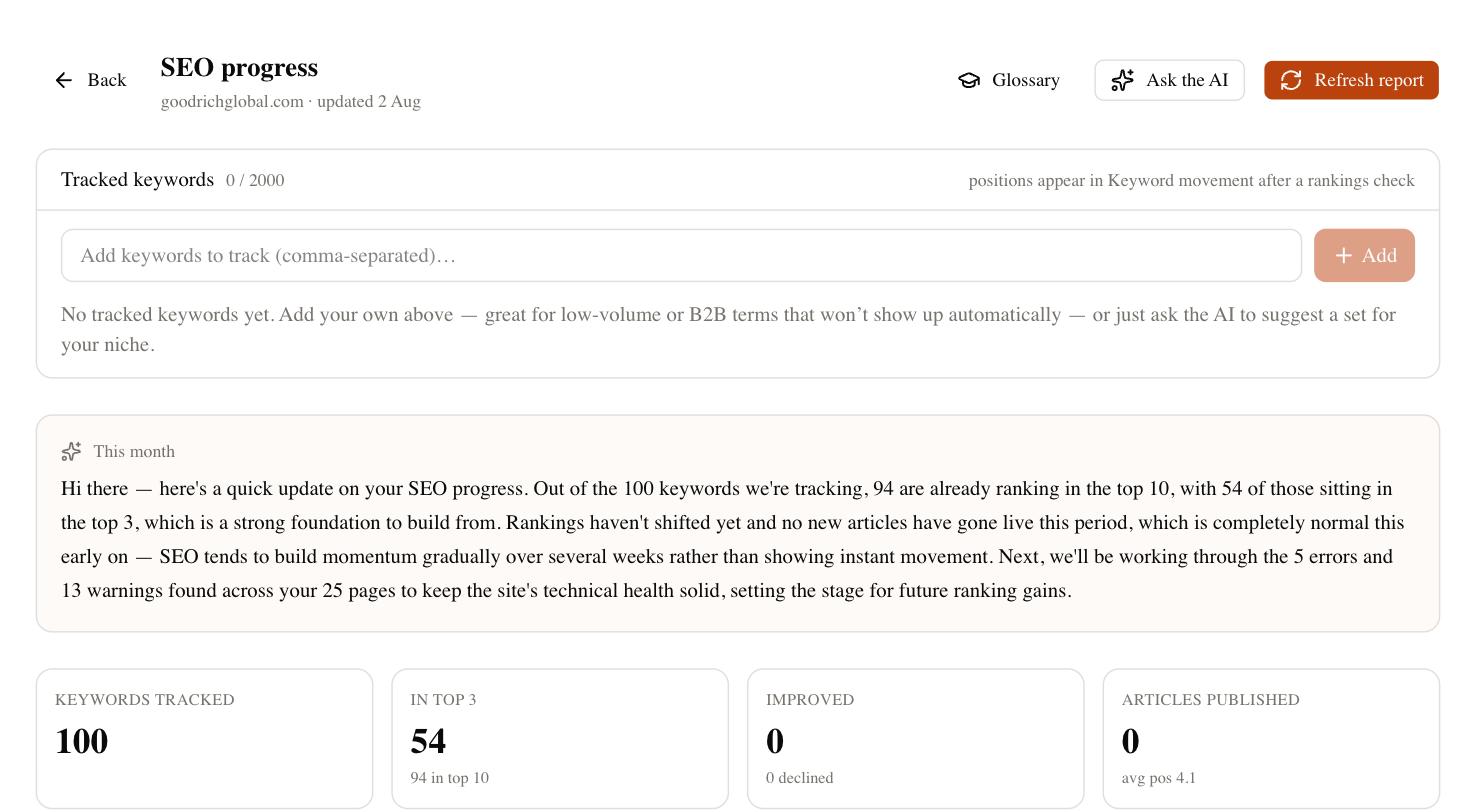
From there the same tool drafts the service and location pages with Claude, tracks your local rankings as they move, and — through Brand Radar — shows whether AI search tools like ChatGPT and Perplexity mention your firm when someone asks them to recommend an IT provider. For an agency or a solo consultant serving IT clients, the client dashboard hands over a clean, white-label report without any exporting. It replaces the usual stack of a keyword tool, a writer, and a rank tracker with one connected workflow.
A priority checklist to start this month
Don’t try to do everything at once. Work down this list in order, finish one item before starting the next, and you’ll see movement before the quarter is out.
- Claim and fully complete your Google Business Profile, then ask five recent clients for reviews.
- Split your services page into one dedicated page per core service.
- Build a location page for each city you genuinely serve, with real local detail.
- Add one vertical page for your best niche (“IT support for [industry]”).
- Publish an honest pricing guide targeting “how much does managed IT cost.”
- Write two problem-aware blog posts that link to the relevant service pages.
- Earn three local, relevant links from partners, associations, or directories.
That sequence covers the trust signals, the commercial pages, and the top-of-funnel content that make an IT company visible to the buyers actually ready to hire. Start with the profile and the service pages, measure over a full ranking cycle, and expand into national or vertical plays only once your local base is solid.