The Ahrefs vs Moz question usually comes down to one honest trade-off: raw data depth against a gentler learning curve. Ahrefs has spent years building one of the largest link and keyword indexes in the industry, and it shows in the numbers. Moz built its reputation on being the tool that doesn’t scare beginners off, with a cleaner interface and the domain authority metric that half the industry still quotes in pitch decks.
Neither is a bad choice, and this comparison won’t pretend one is. Below is a segment-by-segment look at how the two stack up on the things you actually pay for — data quality, ease of use, AI features, price, and who each one genuinely fits — followed by a third option worth knowing about if your real problem is tool sprawl.
The short version
If you live in backlink data and competitive research, Ahrefs is the stronger instrument and it isn’t close. If you’re newer to SEO, manage a small site, or just want a tool that doesn’t require a weekend of tutorials, Moz is the friendlier home and costs less to get started. Most of the disagreement people have about these two isn’t really about the tools — it’s about which of those two situations they’re in. Sort that out first and the choice mostly makes itself.
Ahrefs vs Moz at a glance
Here’s the head-to-head across the dimensions that matter, with a third column for the AI-native alternative covered further down. Treat the price bands as rough — both vendors change plans, and third-party metrics like domain rating and domain authority are estimates, not gospel.
| Dimension | Ahrefs | Moz Pro | SEO Rocket |
|---|---|---|---|
| Data quality | Very large, fresh link & keyword index | Solid but smaller index | Ahrefs-grade data under the hood |
| Ease of use | Dense; steep learning curve | Clean, beginner-friendly UI | Chat-first — ask in plain English |
| AI features | Limited; mostly traditional tooling | Limited; traditional tooling | AI writing + AI-search visibility built in |
| Best for | Link builders, agencies, heavy research | Beginners, small sites, learners | Solo SEOs, consultants & agencies |
| Rough price band | Higher — low hundreds/mo to start | Mid — roughly $99–$150/mo entry | Low / entry-friendly |
Data quality and index size
This is the clearest gap between them. Ahrefs crawls the web aggressively and its link index is one of the biggest and freshest you can buy, which is why serious link builders and competitive researchers reach for it first. When you’re auditing a competitor’s backlink profile or hunting link gaps at scale, the difference in how many referring domains each tool surfaces is real and it matters. Ahrefs simply sees more of the web.
Moz’s index is smaller. For a small site tracking a few dozen keywords and its own link growth, you may never feel the ceiling — Moz’s data is perfectly usable, and its domain authority score remains a widely understood shorthand. But push into deep competitive work and you’ll notice Moz reporting fewer links and thinner keyword sets. On pure data, the honest verdict goes to Ahrefs.
Ease of use and learning curve
Flip the question to usability and the verdict flips with it. Ahrefs is powerful, but it’s dense — most people use maybe a fifth of it and still feel like they’re missing menus. There’s a genuine learning curve, and if you’re new to SEO the sheer number of reports can be paralyzing. That depth is the point for a professional, but it’s a tax on a beginner.
Moz has always aimed at exactly that beginner. The interface is cleaner, the reports are easier to read at a glance, and the onboarding assumes you don’t already know what a referring domain is. For a small business owner, a marketer wearing five hats, or anyone learning the ropes, Moz is the more comfortable place to start. On ease of use, the verdict goes to Moz.
AI features: where both tools are behind
Here neither one earns a clear win, and that’s the interesting part. Both Ahrefs and Moz were architected before AI writing and AI search became daily concerns, and it shows. Each has added assistive touches around the edges, but neither treats content generation or AI-answer visibility as a first-class part of the workflow. You still export data, open a separate writing tool, draft your article, then wonder whether ChatGPT or Perplexity ever cites you at all.
That last point is quietly becoming the whole game. A growing share of buyers now ask an AI assistant instead of scrolling Google, and a page that ranks first can still be invisible in an AI-generated answer. Traditional rank tracking — which both of these tools do well — tells you nothing about that surface. If AI visibility is on your radar, neither Ahrefs nor Moz answers it today, and you’ll be adding a third subscription to cover the gap.
Pricing: what you’ll actually pay
On cost, the two sit in different tiers. Moz’s entry plans generally land in the mid range, roughly around one hundred to a hundred and fifty dollars a month, and its lower tiers make it the cheaper way to get real SEO data. Ahrefs starts higher — think low hundreds a month before you add seats or extra projects — and its credit system can burn faster than you expect on a busy account.
The pattern holds as you scale. Add users, add projects, add the volume a working agency needs, and Ahrefs climbs quickly. Moz stays gentler on the invoice but gives you less depth for the saving. Neither is overpriced for what it is; you’re choosing whether you’re paying for index depth or for an easier, cheaper on-ramp. For budget-conscious beginners the verdict leans Moz; for teams whose revenue depends on link data, Ahrefs earns its higher bill.
SEO Rocket: the AI-native third option
There’s a reason so many people comparing these two end up unsatisfied with both: the real complaint is usually the workflow, not the tool. You want one place to research, write, and track — and the traditional suites make you stitch that together yourself. SEO Rocket was built for that gap. Instead of a wall of tabs, you ask for what you need in plain language and it runs the lookup on real, Ahrefs-grade data underneath — keyword research, competitor gaps, backlink profiles, rank tracking.
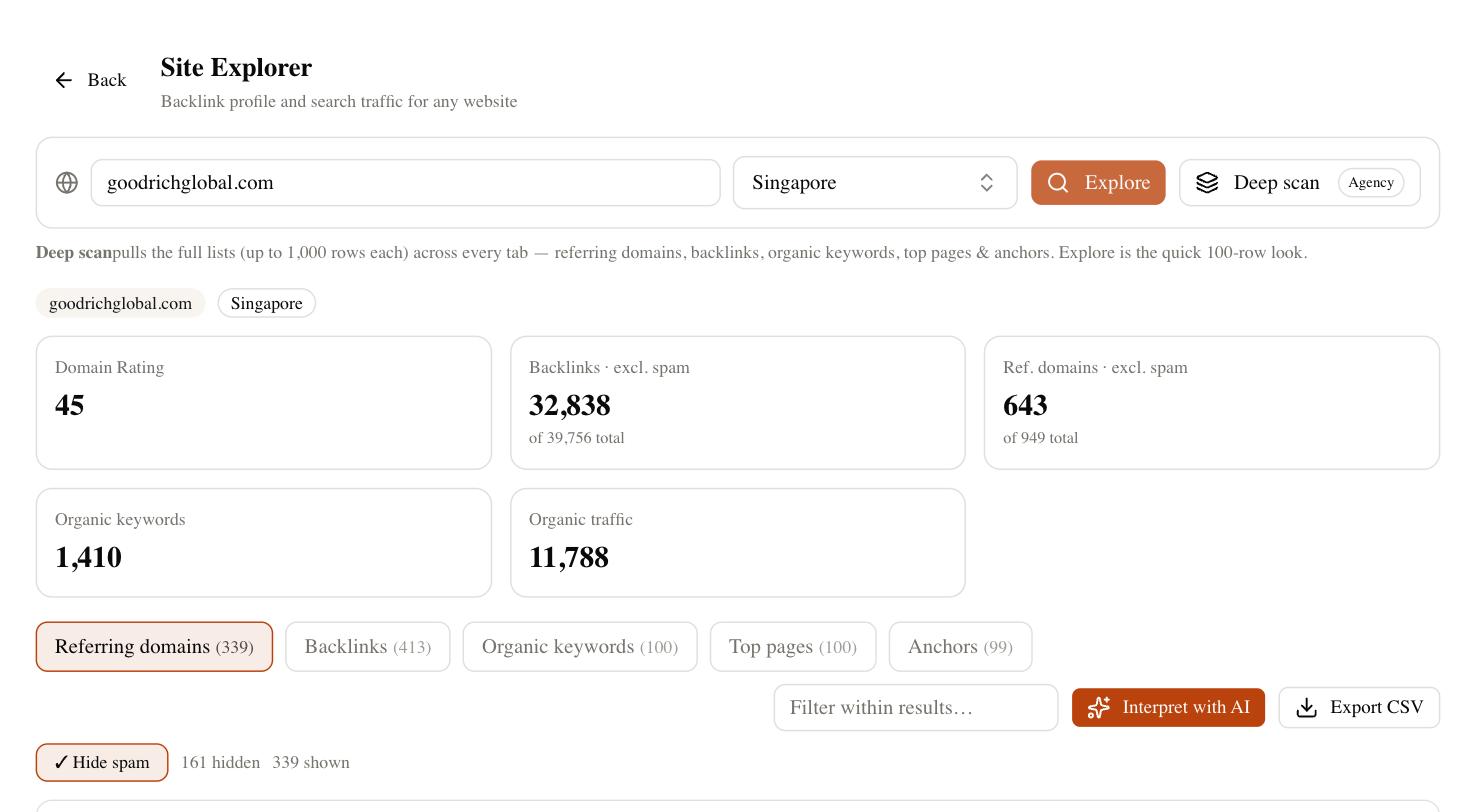
The difference isn’t the underlying data — it’s what happens next. The same tool drafts the article with Claude and shows you whether your brand is being cited across ChatGPT, Perplexity, and Google’s AI Overviews through its Brand Radar view. A stack of Ahrefs (or Moz) plus a separate AI writer plus an AI-visibility tracker collapses into one subscription, and the entry pricing undercuts a comparable Ahrefs plan. If you’re a consultant or agency, the client-dashboard side hands a read-only report straight to a client with nothing to export.
It isn’t the right pick for everyone. If your entire job is deep, forensic backlink auditing, Ahrefs still has the larger index and you should stay. But if your week is some mix of checking rankings, sizing up a competitor, and producing content, an AI-native tool covers those three faster than juggling two legacy subscriptions — and it answers the AI-visibility question neither Ahrefs nor Moz touches.
How to choose between them
Match the tool to your real constraint, not to a feature checklist. Pick Ahrefs if backlink analysis and competitive research are the core of your work and the budget is there — its data depth is genuinely hard to replace, and link builders rarely regret it. Pick Moz if you’re newer, running a smaller site, or you simply want a cleaner, cheaper tool that won’t overwhelm you while you learn; you’ll trade some index size for a much gentler experience.
And if the thing driving you nuts is running three tools to do one job — researching in one, writing in another, guessing at AI visibility with a fourth — look at an AI-native option before you commit to either. A fast way to decide: write down the three tasks you actually did in your SEO tool last week. If they’re heavy link audits, Ahrefs wins. If they’re gentle keyword and rank checks on a budget, Moz does. If they’re research-plus-content-plus-visibility, neither legacy tool is really built for your week anymore. Whichever you choose, give it a full ranking cycle before judging — positions jitter a few spots day to day, and no tool’s estimates are exact.