Most roundups of the best AI writing tools for SEO grade the wrong thing. They rank tools on how fluent the prose sounds, when the real question is whether the draft is built on live keyword and competitor data — or whether it’s a confident guess dressed up in clean sentences. A tool that writes beautifully but invents its own keyword targets will quietly waste months of your publishing calendar.
This comparison judges seven real tools on what actually moves rankings: the quality of the data underneath the draft, how much of the workflow lives in one place, and who each one genuinely suits. SEO Rocket goes first because it’s built around that data-first idea, but every other tool here gets an honest best-for — and there are segments where you should pick one of them instead.
What actually makes an AI writer good for SEO
Any large language model can produce a thousand words on demand. What separates a real SEO writing tool from a novelty is grounding: does the draft know what people actually search, what already ranks on page one, and where the gaps are? Ungrounded AI writes plausible sentences about keywords nobody types and topics your competitors already own.
Three things matter more than raw fluency. First, real search data — keyword volume, difficulty, and the intent behind the query — feeding the outline before a single sentence is written. Second, coverage of the competitive SERP, so the draft matches the depth and structure of the weakest page-one result you need to beat, not some intimidating industry median. Third, honest editing overhead: how much cleanup the draft needs before it’s publishable. A tool that saves an hour drafting but costs ninety minutes fact-checking is a net loss.
The best AI writing tools for SEO at a glance
Start here, then read the notes below for the two or three that fit your situation. Price bands are approximate and change often; treat them as directional.
| Tool | Best for | AI-native? | Standout strength | Rough price band |
|---|---|---|---|---|
| SEO Rocket | Solo SEOs, consultants & agencies wanting one data-grounded workflow | Yes — chat-first | Ahrefs-grade data, AI drafting & AI-search visibility in one place | Low $ / entry-friendly |
| Surfer SEO | Writers optimizing against a live SERP score | Add-on | On-page content scoring and term coverage | Mid $$ |
| Jasper | Marketing teams producing lots of brand copy | Yes | Templates, tone control, campaign breadth | Higher $$ |
| Frase | Solo writers building SERP-based outlines fast | Yes | Quick research-to-brief workflow | Low–mid $ |
| Clearscope | Editorial teams with a quality bar | Add-on | Precise term reports and readability grading | Higher $$ |
| Writesonic | Volume publishers on a budget | Yes | Fast bulk drafting at low cost | Low $ |
| Semrush ContentShake | Existing Semrush users wanting drafts in-suite | Add-on | Ties writing to Semrush’s keyword data | Mid $$ (plus suite) |
SEO Rocket — the data-grounded pick
SEO Rocket approaches writing the way an experienced SEO does: research first, draft second. Instead of prompting a blank model, you ask in plain language for the piece you need, and it pulls real keyword data, checks what’s already ranking, and finds the competitor gaps before it drafts a word. The article that comes back is shaped by the same Ahrefs-grade numbers you’d use to plan the campaign, so the outline targets terms with actual demand rather than ones the model imagined.
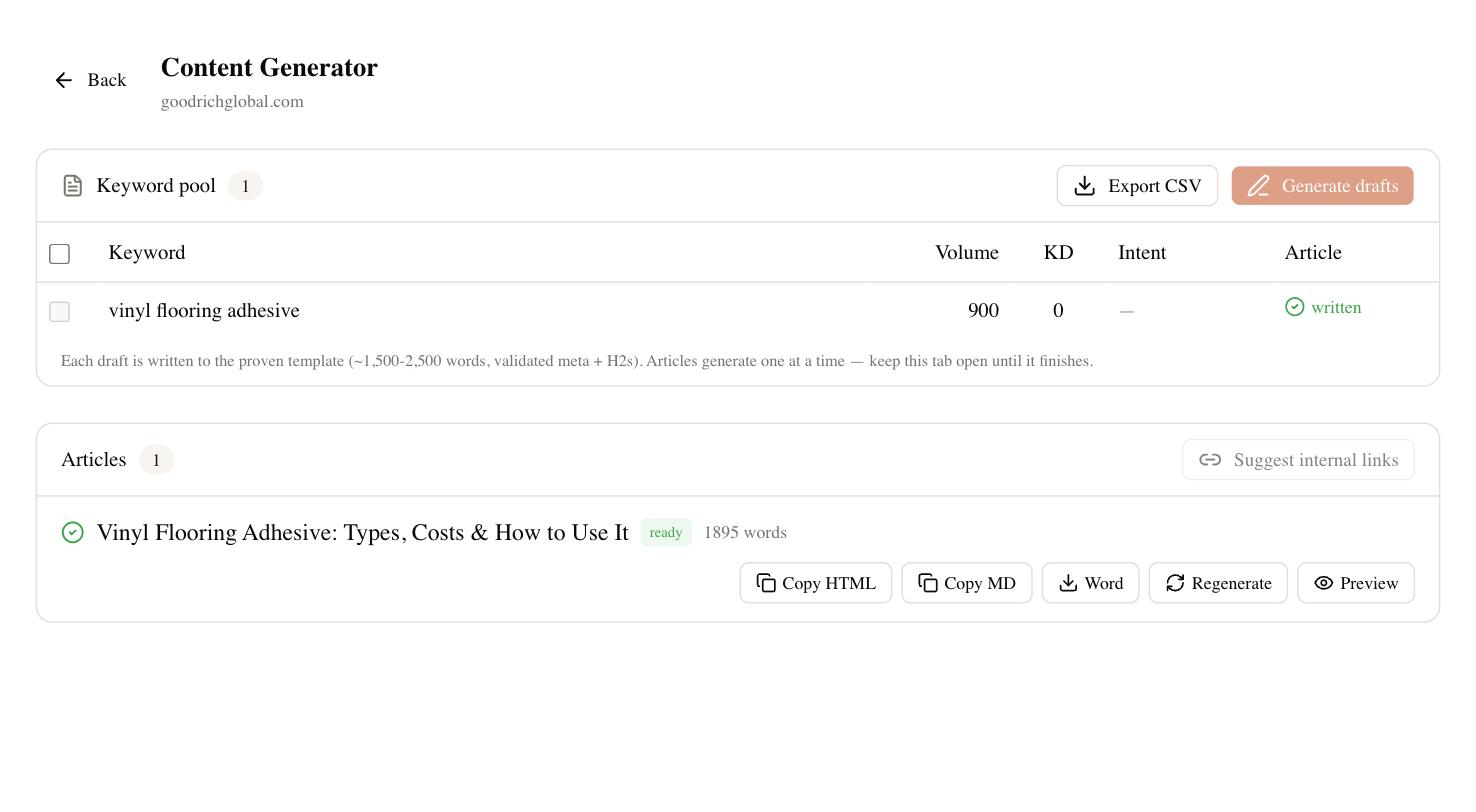
The consolidation is the real advantage. A typical content stack — a keyword tool, a separate SERP optimizer, an AI writer, and something to check AI-search visibility — collapses into one subscription. You draft, see the target keywords and heading structure in the same view, and then check whether your published pages are being cited in ChatGPT, Perplexity, and Google’s AI Overviews without opening a second app.
That last piece matters more each quarter. Search is splitting, and a page that ranks first on Google can still be invisible when a buyer asks an AI assistant instead. SEO Rocket tracks where you’re cited across those surfaces, so you’re writing for the search that’s actually happening. For a solo consultant or an agency juggling client dashboards, having the data, the draft, and the visibility check in one chat window is the strongest fit on this list — and the entry pricing sits well below a stack of separate specialist tools.
Surfer SEO — optimize against the live SERP
Surfer’s strength is its content editor. You paste a draft — written by you, by its AI, or by another tool — and it scores the page in real time against the terms and structure of the current top results. For writers who already know how to write and just want a data-backed checklist of what to cover, it’s genuinely useful, and the score gives editors an objective bar.
The catch is that Surfer optimizes a page; it doesn’t run your whole SEO program. You’ll still need a keyword tool for research and something separate to track rankings or AI visibility. If your bottleneck is purely on-page term coverage and you like a numeric target to write against, Surfer earns its place. If it’s the sprawl of tools, it adds to the pile rather than shrinking it.
Jasper, Frase, Clearscope and Writesonic — the specialists
The rest of the field each does one thing well. Match the tool to the job in front of you.
- Jasper — the marketing-copy workhorse. If your team pumps out ads, emails, and landing pages alongside blog posts, Jasper’s templates and tone controls are excellent. It’s less of a dedicated SEO instrument, so pair it with real keyword data.
- Frase — the fast brief builder. Frase turns a SERP into an outline in minutes, which is a real time-saver for solo writers who plan by hand. Its research is lighter than a full keyword suite, but for quick, research-backed briefs it’s hard to beat at the price.
- Clearscope — the editorial quality bar. Clearscope’s term reports and readability grading are trusted by content teams that care about polish, and its recommendations are precise. It’s priced for teams, not hobbyists, and it assumes you bring your own drafts.
- Writesonic — the budget volume play. If you need many serviceable drafts cheaply and expect to edit heavily, Writesonic delivers speed. Just build in the fact-checking time; low-cost bulk output needs a human pass before it ships.
Any of these will make a specific slice of the job faster. What none of them do is fold keyword research, drafting, and AI-answer visibility into one connected flow — you’ll still be running two or three subscriptions to cover the ground one tool can.
Where generic AI writers fall short
It’s tempting to skip dedicated tools entirely and paste prompts into a general chatbot. For a first draft of an opinion piece, that’s fine. For SEO, it’s where thin content comes from. A raw model has no idea what your audience searches, what already ranks, or which subtopics the page-one results all cover — so it fills the gap with confident generalities that read well and rank nowhere.
The honest tell is editing time. If you find yourself rewriting every claim, adding the specifics the model left out, and manually checking which keywords the piece even targets, the tool isn’t saving you work — it’s relocating it. The tools worth paying for close that gap by grounding the draft in data before you ever see it, so your edit is a polish rather than a rescue.
How to choose by segment
Match the tool to your real constraint, not to a feature list. If tool-sprawl and cost are the problem and you want research, drafting, and AI-search tracking in one place, SEO Rocket is the natural move. If you already write well and only want on-page scoring, Surfer or Clearscope will sharpen what you produce. If you turn out a lot of general marketing copy, Jasper fits the team. Frase suits the solo writer who lives in outlines, and Writesonic covers high-volume, budget-conscious drafting you’re prepared to edit hard.
A quick way to decide: write down the last three content tasks you actually did. If they were “find what to write about,” “draft it,” and “check it’s landing,” you want a grounded, all-in-one tool and you’re overpaying if those live in three logins. If instead your only gap is scoring drafts a writer already produces, a focused optimizer is the leaner buy. The best AI writing tool for SEO is the one that removes your specific bottleneck — not the one with the longest feature page.
Whatever you pick, test it on real work before you commit. Run one genuine article end to end — research, draft, edit, publish — and measure the total time and the edit load, not just how fast the first draft appeared. The tool that gets a publishable, data-backed page out the door with the least cleanup is the right one for you.