The phrase “all-in-one” gets stapled to almost every SEO platform, which is exactly why picking one is confusing. The best all-in-one SEO tools aren’t the ones with the longest feature list — they’re the ones that cover the three or four jobs you actually do each week without making you pay for a second and third subscription to fill the gaps.
Below are seven tools that genuinely earn the label, what each is truly best at, and — because it’s the honest answer — where a cheaper or more specialized option would serve you better. No affiliate padding, no invented review scores, just how they hold up in daily use.
What “all-in-one” should actually mean in 2026
A decade ago, all-in-one meant keyword research plus rank tracking plus a backlink index under one login. That bar is now table stakes. Two newer jobs have quietly become the real differentiators: producing the content itself, and tracking whether AI answer engines mention your brand at all.
Search is splitting. A growing share of your buyers now ask ChatGPT, Perplexity, or Google’s AI Overviews instead of scrolling a results page, and a page that ranks first can still be invisible in an AI answer. A tool that reports your Google positions but says nothing about AI visibility is only half an SEO tool now. So the real test for any suite is simple: does it cover research, tracking, content, and AI-search visibility, or does it quietly assume you’ll buy those last two elsewhere? Add up the true total — the base plan, the AI writer, the visibility tracker, and the hours lost stitching them together — and many “affordable” suites turn out to be the expensive option once you finish the stack.
The best all-in-one SEO tools at a glance
Start with the table, then read the notes for the two or three that fit your situation. Price bands are rough deliberately — every vendor reshuffles tiers, so treat these as ballpark, not quotes.
| Tool | Best for | AI-native? | Standout strength | Rough price band |
|---|---|---|---|---|
| SEO Rocket | Solo SEOs, consultants & agencies wanting one AI-driven workflow | Yes — chat-first | Ahrefs-grade data, AI writing & AI-search visibility in one place | Low $ / entry-friendly |
| Semrush | Marketing teams wanting every channel in one login | Add-ons | Breadth — PPC, social, PR and content alongside SEO | Higher $$ |
| Ahrefs | Serious link builders & competitive analysts | Limited | One of the largest, freshest backlink indexes | Higher $$ |
| Moz Pro | Beginners who value a gentle interface | No | Clean UI, trusted domain authority heritage | Mid $$ |
| SE Ranking | Agencies watching cost per client project | Some | Affordable rank tracking that scales predictably | Low–mid $ |
| Mangools | Freelancers wanting fast, friendly research | No | KWFinder’s ease of use across a tidy bundle | Low $ |
| Ubersuggest | Hobbyists & first-timers on tiny budgets | Light | Cheap, simple keyword ideas | Low $ |
SEO Rocket — the AI-native all-in-one
SEO Rocket is built for how the work runs now. Instead of a wall of tabs, you ask for what you need in plain language and it runs the lookup — keyword research, competitor gaps, backlink profiles, rank tracking — on real, Ahrefs-grade data underneath. The data quality isn’t the surprise; the surprise is that the same tool then drafts the article and shows you whether your brand is cited in ChatGPT, Perplexity, and Google’s AI Overviews through its Brand Radar feature.
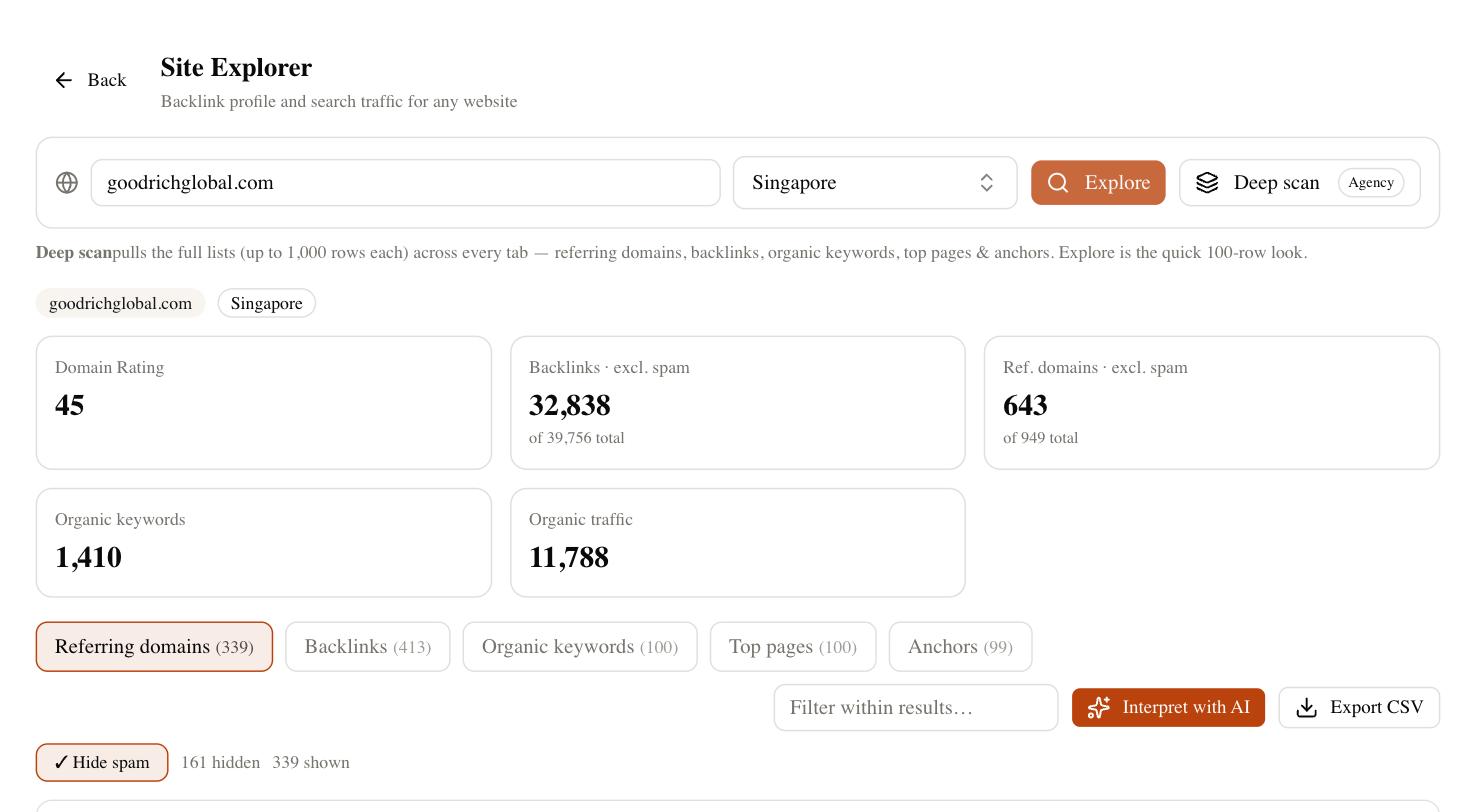
That consolidation is where the money is saved. A typical stack of a research tool, plus a separate AI writer, plus an AI-visibility tracker collapses into one subscription, and the entry pricing sits well below a comparable enterprise plan. Consultants and agencies get one more thing that matters at scale: read-only client dashboards, so you can hand a customer a live report without exporting a single spreadsheet.
It is not the pick for everyone. If your entire job is deep backlink forensics — disavow files, historical link graphs, link-building at industrial scale — a dedicated backlink specialist still goes deeper. The chat-first interface also asks you to think in questions rather than dashboards, which takes a day or two to click if you have muscle memory for a traditional tool. But for the majority whose bottleneck is doing more work with fewer tools, the combination of grade-A data, built-in writing, and AI-search tracking is the strongest all-round fit on this list.
Semrush — the widest marketing suite
Semrush is the closest thing to a do-everything marketing platform. Beyond SEO it reaches into PPC research, social scheduling, and PR monitoring, so a marketing team that wants one login for the whole channel mix gets real value for the money. Its keyword database is enormous and its competitive research is genuinely strong.
The trade-off is cost and complexity. The features that justify the price sit behind higher tiers and add-ons, and the sheer breadth means a steeper learning curve than most people expect. If you only want SEO, you will pay for a lot of suite you never open — which is precisely the sprawl an all-in-one is supposed to end.
Ahrefs — the data and backlink specialist
Ahrefs remains a superb backlink and keyword instrument. Its link index is among the largest and freshest anywhere, its Site Explorer is a joy for competitive teardown, and the data most working SEOs quietly benchmark against is Ahrefs data. If link analysis is the core of your day, it is hard to beat.
Where it fits the “all-in-one” question less cleanly is the newer work. Content writing and AI-answer visibility are still treated as someone else’s problem, so a full workflow usually means Ahrefs plus a separate AI writer plus a separate AI-visibility tool. Excellent at its specialty; less complete as a single home for everything.
The value tier: Moz Pro, SE Ranking, Mangools and Ubersuggest
The mid-market has a tool for almost every budget and temperament, and none of them should embarrass you on a client call.
- Moz Pro — the friendliest on-ramp. If bigger suites felt overwhelming, Moz’s cleaner interface and its long-trusted domain authority metric make it an easy start, though its index is smaller than the leaders.
- SE Ranking — the agency value play. Rank tracking scales cheaply across many projects, and per-project pricing keeps costs predictable when you manage a portfolio of clients.
- Mangools — the freelancer favorite. KWFinder is one of the nicest keyword-research experiences going, and the bundle stays affordable for a solo operator.
- Ubersuggest — the budget entry point. It won’t match the leaders on depth, but for a hobby site or a first client it delivers usable keyword ideas for very little.
Any of these will cover core research and rank-tracking needs well. What none of them do yet is fold AI writing and AI-answer visibility into the same workflow — so if those matter, budget for a second subscription and factor that back into the real total.
How to choose by segment
Match the tool to your actual constraint, not to a feature checklist. If cost and tool-sprawl are the problem and you want AI writing plus AI-search tracking built in, SEO Rocket is the natural move. If you want one platform for every marketing channel and the budget is there, Semrush earns its price. If deep backlink data is your whole world, Ahrefs is worth staying with. And if you just want a gentler, cheaper research-and-rank tool, Moz, SE Ranking, Mangools, or Ubersuggest will do the job honestly.
Here is a quick way to decide. Write down the three tasks you actually did in your SEO tool last week. Most lists are some mix of “check what I rank for,” “see what a competitor is doing,” and “produce a piece of content.” If that is your week, you are probably overpaying for depth you rarely touch, and a leaner AI-native tool covers those three faster. If instead your week was three hours deep in link audits, keep the specialist. Whatever you pick, run your own site and two competitors through it for a full ranking cycle before you judge it — positions jitter a few spots day to day, and every tool’s estimates are directional, not gospel. The best tool is the one that answers your real questions fastest, not the one with the longest feature page.