The best competitor analysis tools all answer the same three questions: what are my rivals ranking for that I’m not, where is their traffic actually coming from, and what would it take to close the gap. Everything else is packaging. The problem is that most roundups bury that under a dozen near-identical entries and affiliate links, so you leave knowing every tool exists and none of what they’re for.
This comparison is shorter and more opinionated. Below are seven tools that genuinely earn a place in a competitor-research workflow, an honest read on what each one is best at, and a clear answer to the only question that matters — which one fits how you actually work. I’ll tell you when a rival beats us, because on some jobs it does.
What competitor analysis actually requires
Competitor analysis is not one feature; it’s four jobs stacked together. First, an organic gap: the keywords a competitor ranks for that you don’t, sized by volume and difficulty so you know which are worth chasing. Second, a traffic picture: where their visitors come from — search, paid, referral, direct — so you’re not copying a channel mix that doesn’t apply to you. Third, a link and authority read, because outranking someone often means matching the domains pointing at them. Fourth, and newer, AI-search visibility: whether a competitor is being cited in ChatGPT, Perplexity, and Google’s AI Overviews on the queries you both care about.
Almost every tool nails one or two of those. The gap between a decent tool and a great one is how many of the four it covers without forcing you into a second subscription — and how quickly it turns raw numbers into a next action. A gap report with two thousand keywords is noise; the same report filtered to the twenty terms you can realistically win this quarter is a plan. Speed to that plan is what separates the tools below, far more than any difference in their raw index size.
How I compared them
Each tool here was judged on four things a working SEO cares about: the quality and freshness of the underlying data, honest total cost rather than the headline number, whether AI content and AI-search visibility are built in or bolted on, and who the tool is genuinely for. Remember that cross-tool metrics — domain rating, traffic estimates, keyword difficulty — are modeled approximations, so treat differences between platforms as directional, not gospel. Benchmark yourself against the weakest competitor already ranking on page one, not the category leader with a decade of links; that weakest rival is the realistic target, and every tool below can find them for you.
Best competitor analysis tools at a glance
Start with the table, then read the notes on the two or three rows that match your situation.
| Tool | Best for | AI-native? | Standout strength | Rough price band |
|---|---|---|---|---|
| SEO Rocket | Solo SEOs, consultants & agencies wanting one AI-driven workflow | Yes — chat-first | Ahrefs-grade gap data + AI writing + AI-search visibility in one place | Low $ / entry-friendly |
| Ahrefs | Link-led SEOs and deep backlink audits | Add-ons | Large, fresh backlink index and content gap | Higher $$ |
| Semrush | Marketing teams wanting the whole channel mix | Add-ons | Breadth — organic, PPC, PR, social in one login | Higher $$ |
| Similarweb | Analysts studying traffic sources & market share | Some | Whole-site traffic and channel breakdowns | Higher $$$ |
| SpyFu | Budget PPC and paid-vs-organic research | No | Competitor ad history at a low price | Low $ |
| SE Ranking | Agencies watching cost per client | Some | Affordable gap analysis and rank tracking at scale | Low–mid $ |
| Moz Pro | Beginners who value a gentle interface | No | Clean UI, trusted domain authority metric | Mid $$ |
SEO Rocket — the AI-native pick
SEO Rocket is built for how competitor research works now. Instead of hopping between tabs, you ask in plain language — “show me what these three competitors rank for that I don’t” — and it runs the gap on real, Ahrefs-grade data underneath, returning keywords sized by volume and difficulty. The data isn’t the differentiator; the workflow is. The same tool then drafts the article to close the gap and shows whether your brand is being cited in ChatGPT, Perplexity, and Google’s AI Overviews, which no traditional competitor tool answers.
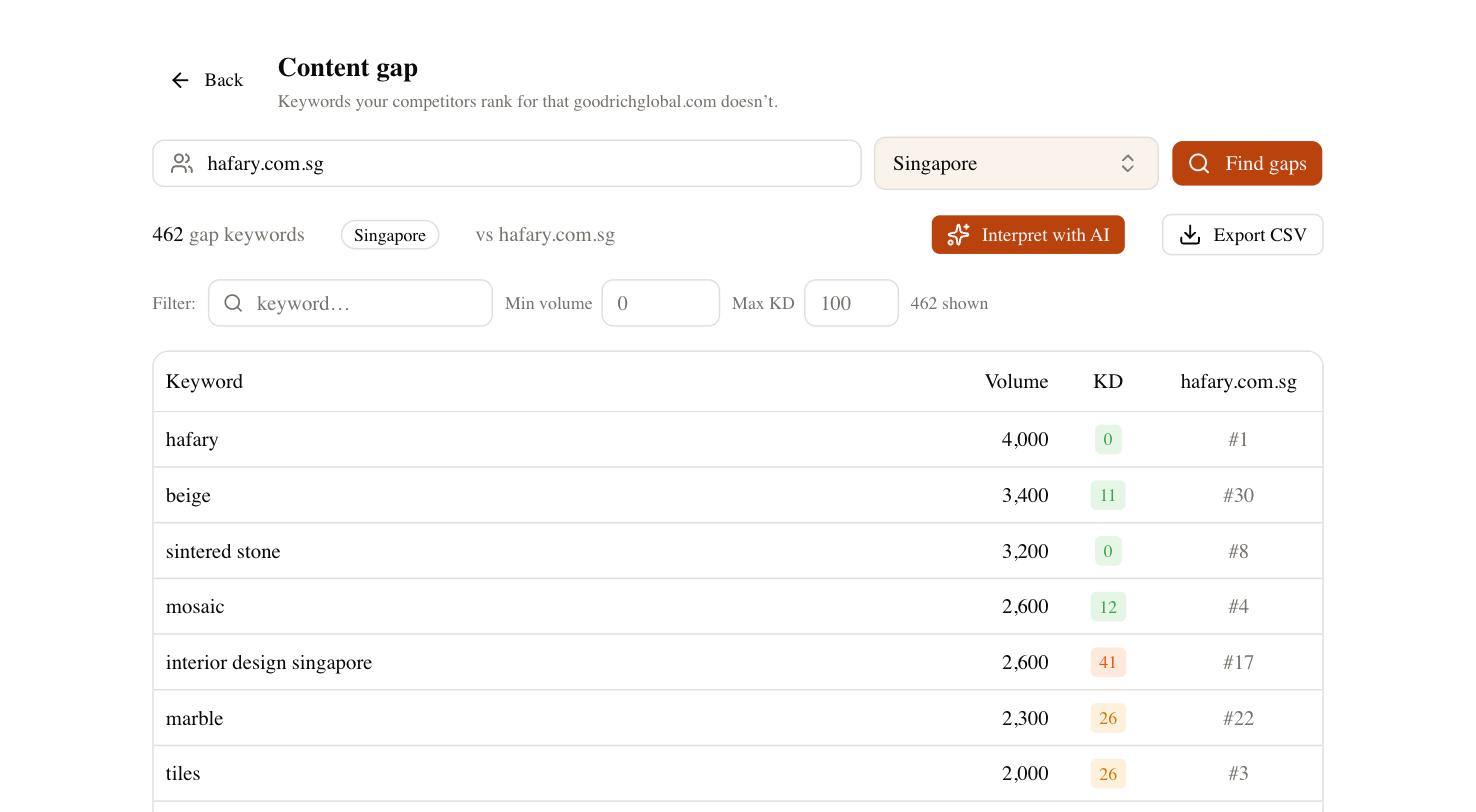
That consolidation is the real saving. A typical competitor-research stack — a backlink-and-keyword tool, a separate AI writer, and an AI-visibility tracker — collapses into one subscription at a fraction of a comparable enterprise plan. For consultants and agencies, the client-dashboard side means you can hand a read-only competitor report straight to a client without exporting anything or paying per seat. If your bottleneck is doing more research with fewer tools, which describes most people reading this, it’s the strongest fit on the list.
Ahrefs and Semrush — the heavyweights
Ahrefs remains the reference for link-led competitor work. Its backlink index is one of the largest and freshest going, and its Content Gap and Site Explorer views are what most people picture when they think competitor analysis. If your work lives on link audits, disavow files, and matching a rival’s referring domains, Ahrefs is hard to beat — you’ll just pay for the depth, and pay again for a separate writer and AI tracker.
Semrush is the broadest option. Beyond organic it covers PPC research, ad copy, PR monitoring, and social, so a marketing team that wants one login for every channel gets real value studying a competitor’s whole footprint. The trade-off is familiar: it’s expensive once you add the modules that justify it, and the breadth is a steeper climb. If you only need SEO competitor data, you’ll pay for a lot of suite you never open.
Similarweb, SpyFu, SE Ranking and Moz Pro
The rest of the field is strong in narrower lanes, and one of them may be exactly what you need.
- Similarweb — the traffic-source specialist. If you care less about individual keywords and more about where a competitor’s whole audience comes from and how big their market slice is, nothing reads channel mix and referral traffic better. It runs at enterprise prices.
- SpyFu — the budget paid-search play. It’s cheap and its historical view of a competitor’s Google Ads copy and spend is genuinely useful, especially when you’re weighing paid against organic. Its organic data is shallower than the leaders.
- SE Ranking — the agency value pick. Gap analysis and rank tracking scale affordably across many client projects, and predictable per-project pricing keeps a portfolio’s costs sane.
- Moz Pro — the friendly on-ramp. If bigger tools felt overwhelming, Moz’s cleaner interface and its long-trusted domain authority score make competitor comparison approachable, though its index is smaller.
Each covers its core job well. What none folds in yet is AI writing and AI-answer visibility in the same place — you’ll still run a second subscription for that side of the work.
How to choose by segment
Match the tool to your real constraint, not a feature checklist. If you’re a solo SEO, consultant, or agency who wants the gap, the content, and AI-search tracking in one AI-native workflow, SEO Rocket is the natural move. If deep backlink data is your whole world, stay with Ahrefs. If you need every marketing channel under one roof, Semrush earns its price, and if you’re studying market share and traffic sources, Similarweb is purpose-built. On a tight budget, SpyFu covers paid research and SE Ranking covers affordable gap analysis at scale, while Moz Pro is the gentlest starting point.
A quick test before you commit: run your own site and your two nearest competitors through any shortlisted tool for one week. Write down the three questions you actually asked — most people’s list is some version of “what are they ranking for that I’m not,” “where’s their traffic coming from,” and “what do I publish next.” The best of the competitor analysis tools for you is simply the one that answers those three fastest, and lets you act on the answer without opening a second tab. Give it a full ranking cycle before judging, since positions jitter a few spots day to day, and buy the workflow you’ll actually use on a Tuesday.