
Most articles about a competitor analysis template describe one and then never hand it over. This one gives you the real thing: a checklist you can copy into a doc, a filled example table you can paste over with your own numbers, and an honest read on which rows matter and which are noise. Use it on three rivals and you’ll know exactly where you’re losing ground and what to do about it.
A good competitor analysis template isn’t a spreadsheet with forty columns. It’s a short list of questions that change what you do next week. Everything below is built around that test — if a metric wouldn’t change your plan, it isn’t in here.
The template: what every row should capture
Start by picking three to five competitors — not your aspirational rivals, but the sites that actually outrank you for the keywords you care about. Then fill one row per competitor against these fields. The checklist below is the whole template; copy it as-is.
The competitor analysis checklist
- Domain & positioning — the site, and the one thing it’s known for.
- Domain Rating / authority — a directional strength score, not gospel.
- Organic traffic (est.) — monthly visits from search, per your tool.
- Ranking keywords — how many terms they rank in the top 100.
- Referring domains — how many distinct sites link to them.
- Top pages — the two or three URLs pulling most of their traffic.
- Content gaps — keywords they rank for that you don’t.
- Weakest page-one page — the softest result you could realistically beat.
- Content format — long guides, tools, listicles, product pages.
- Publishing cadence — roughly how often they ship new pages.
- AI-search visibility — whether they’re cited in ChatGPT, Perplexity, or AI Overviews.
- Your opening — the single most exploitable gap, in one sentence.
That last row is the point of the whole exercise. Everything above it is evidence; the opening is the decision. If you finish a competitor and can’t write that sentence, you haven’t analyzed them yet — you’ve just collected numbers.
A filled example you can copy
Here’s the template filled for a fictional home-services niche, so you can see the shape of a completed row before you build your own. Numbers are illustrative — the format is what to steal. Notice how few fields it takes to reach a decision: a dozen data points across two rivals is enough to name your next move with confidence.
| Field | Competitor A | Competitor B | You |
|---|---|---|---|
| Positioning | Big brand, thin content | Niche specialist blog | Local, service-led |
| Domain Rating | 62 | 38 | 29 |
| Organic traffic | ~48,000/mo | ~9,500/mo | ~2,100/mo |
| Ranking keywords | 14,200 | 3,600 | 780 |
| Referring domains | 1,900 | 310 | 140 |
| Top page | Category hub | “How much does X cost” guide | Homepage |
| Weakest page-one page | Outdated 2022 listicle | Thin 600-word post | — |
| AI-search visibility | Cited in AI Overviews | Not cited | Not cited |
| Your opening | Refresh their stale listicle with better data | Out-depth their cost guide | — |
Read that table and a plan writes itself. Competitor B is the realistic target: lower authority, a thin cost guide ranking on page one, and no AI-search presence. You don’t beat the DR-62 brand this quarter — you take the softest page-one result from the specialist and build from there.
How to choose which competitors to analyze
The most common mistake is analyzing the wrong sites. The brand you envy is rarely the one stealing your specific traffic. Your real competitors are whoever shows up on page one for your money keywords — sometimes a forum thread, a marketplace listing, or a solo blogger, not the household name you assumed.
Pull the top ten results for five of your priority keywords and count who appears most. Those repeat offenders are your list. Then benchmark against the weakest of them, not the strongest — the outdated post at position eight is a far better use of a week than the definitive guide sitting at position one. Beating the median competitor is a fantasy; beating the frailest page-one result is a Tuesday.
Keep the list short. Three competitors done properly beat ten skimmed, because depth is what surfaces the exploitable gaps. If two of your five turn out to be the same brand under different domains, or a marketplace you can’t realistically compete with head-on, drop them and add the next site down. The goal is a list you can actually act against, not a survey of everyone in the space.
Reading the numbers without fooling yourself
Every metric in this template is an estimate, and treating estimates as facts is how good analyses go wrong. Domain Rating and traffic figures differ between tools because each crawls a different slice of the web — cross-tool gaps are directional, not precise. A rival showing “48,000 visits” might really be pulling 30,000 or 70,000; the useful signal is that they’re roughly ten times your size, not the specific number.
Two honest cautions. Referring domains tell you about link strength, but links are necessary, not sufficient — a well-linked page with thin content still loses to a thorough one over time. And a single ranking snapshot lies: positions jitter three or four spots day to day, so a competitor “beating” you at position five today may swap with you tomorrow. Judge trends over a couple of weeks, never a single afternoon’s export.
Filling the template with SEO Rocket
Building this by hand across five competitors means juggling a keyword tool, a backlink tool, a spreadsheet, and a lot of copy-paste. SEO Rocket collapses that into a conversation. You name a competitor in plain language and it pulls the real, Ahrefs-grade numbers behind every row — Domain Rating, organic traffic, referring domains, top pages, and ranking keywords — then lays them out for you.
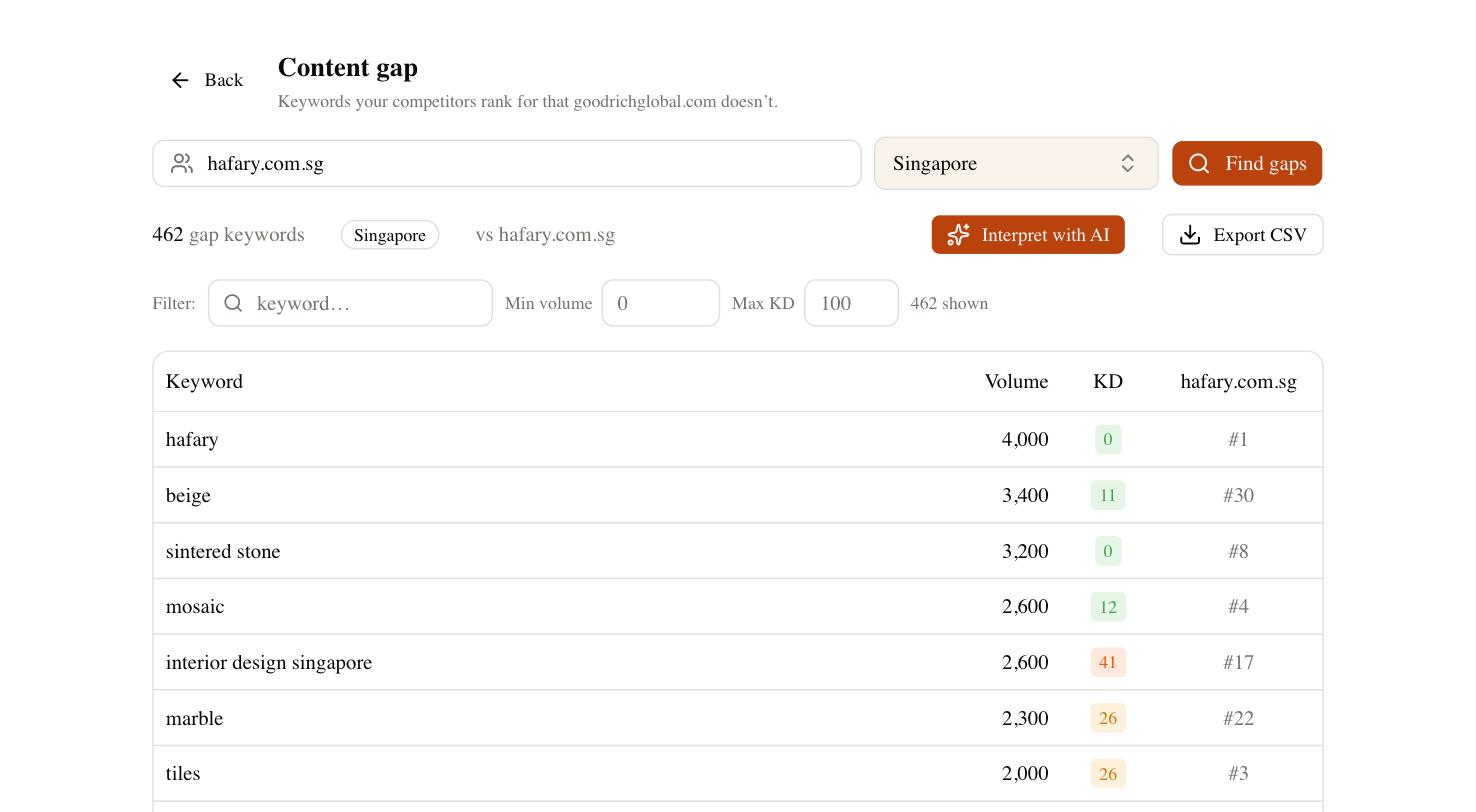
The row that usually takes longest by hand, content gaps, is the one it does best. Its Content Gap view lists the exact keywords your competitors rank for that you don’t, sorted with search volume and keyword difficulty, so you can see at a glance which openings are winnable versus which need authority you don’t yet have.
Two rows in this template didn’t exist a few years ago, and most tools still ignore them. The weakest-page-one field maps to cost-to-rank — an honest estimate of what it takes to overtake a specific result rather than a vague difficulty score. And the AI-search row is answered by Brand Radar, which tracks whether you and your rivals are being cited in ChatGPT, Perplexity, and Google’s AI Overviews. A competitor can trail you in classic rankings yet own the AI answer your buyers now read first, and no traditional template would ever catch it.
Turning the template into a plan
A finished template is worthless until it becomes a to-do list. Work down your “opening” column and turn each sentence into one concrete action with a date. “Refresh their stale listicle with better data” becomes a scheduled rewrite; “out-depth their cost guide” becomes a 2,000-word page with pricing you actually have. Assign each a target keyword and a rough cost-to-rank so you tackle the winnable gaps first.
Then re-run the whole template on a cadence — quarterly is plenty for most sites, monthly if your niche moves fast. Competitor analysis isn’t a one-time report you file and forget; it’s a loop. The sites that pull ahead aren’t the ones with the prettiest spreadsheet. They’re the ones who fill this template, act on the softest opening, and check again next quarter to see what moved.
Give each change a full ranking cycle before you judge it. Refresh a stale page and it may take a few weeks to settle, then move up steadily as the new content earns its position — don’t kill a good bet because week one looked flat. Track the same handful of target keywords over time, watch the trend rather than the daily wobble, and let the results tell you which openings were real. That patience, more than any single tactic, is what separates the sites that compound from the ones that churn.