
SEO for financial advisors is not the same job as SEO for a plumber or a SaaS startup, and treating it like one is why most advisor sites never rank. Your buyers are cautious, high-consideration, and they research for months before they ever fill out a form. Winning them means understanding exactly how someone with $800,000 to invest actually searches before they trust a stranger with it.
Good SEO for financial advisors is really about earning trust at the moment of intent — showing up when a pre-retiree types “fee-only fiduciary near me,” and being the page that answers their fee question honestly. This guide covers the search behavior that’s specific to your niche, the keywords that convert, and the moves that move the needle.
How financial advice buyers actually search
Advisory clients search in stages, and each stage needs a different page. Early on they ask broad, anxious questions: “how much does a financial advisor cost,” “is a financial advisor worth it,” “fiduciary vs financial advisor.” These are research queries, not buying queries, but they’re where trust starts. Answer them plainly and you’re already ahead of the firms that only publish market-commentary fluff.
Closer to hiring, the language changes. They add qualifiers that signal exactly what they want: “fee-only,” “CFP,” “fiduciary,” a city, a life stage, or a profession. Someone typing “financial advisor for physicians in Dallas” is far down the funnel and worth ten times a generic visitor. The whole game is building pages that match those specific, high-intent phrases instead of competing for the impossible head term “financial advisor.”
One more pattern is worth knowing: your prospects rarely convert on the first visit. They read your fee page, leave, ask a friend, read a review, and come back weeks later. That long consideration window means your job isn’t a single killer landing page — it’s showing up helpfully at every touch, so that by the time they book a call you already feel like the safe choice rather than a cold lead.
The money keywords worth targeting
Not every keyword is worth a page. Prioritize the ones with clear commercial intent and realistic difficulty. Here’s how the main buckets break down for a typical independent advisor:
| Example keyword | Intent | Why it converts |
|---|---|---|
| financial advisor [your city] | Local commercial | Ready to hire, near-you intent |
| fee-only financial planner [city] | Local commercial | Self-qualifies on your model |
| financial advisor for doctors / dentists / engineers | Niche commercial | High-value, low-competition |
| retirement planning [city] | Service + local | Names a concrete need |
| how much does a financial advisor cost | Informational | Top-of-funnel trust builder |
| fee-only vs commission advisor | Informational | Catches comparison shoppers |
Chase the niche and local phrases first. “Financial advisor” alone is dominated by national brokerages and lead-gen directories you can’t outspend, but “fee-only financial advisor for tech employees in Austin” is winnable, specific, and pulls in exactly the client you want. The long, qualified queries have less volume each — but they close.
Local versus national intent
Most advisors serve a metro area, which makes local search your highest-leverage channel. A dedicated, genuinely useful page for each city or suburb you serve — not thin doorway pages, but real content about serving clients there — plus a fully built-out Google Business Profile does more for a local practice than a hundred generic blog posts. Reviews matter enormously here; since 2021 SEC rules permit client testimonials under specific conditions, so it’s worth working with compliance to collect them properly.
If you run a niche practice — say you only work with retiring teachers or business owners planning an exit — you can compete nationally on that specialty instead. The audience is smaller but so is the competition, and someone searching “financial advisor for restaurant owners” has effectively pre-qualified themselves. Decide which game you’re playing before you build content, because local and national strategies pull in different directions.
The highest-leverage moves
Skip the busywork and start where the return is real. In rough priority order:
- Build one strong page per service and per location — retirement planning, tax planning, estate planning, each city — instead of one bloated “services” page.
- Answer the fee question openly. A clear page on how you charge outranks vague competitors and pre-qualifies leads.
- Create profession or life-stage pages for the clients you actually want. These are your easiest wins.
- Fix your Google Business Profile and collect compliant reviews. Local pack visibility often beats organic for near-me searches.
- Publish a handful of deep planning guides that demonstrate expertise, not recycled market news.
Notice what’s not on the list: daily blogging, keyword stuffing, and chasing traffic that never converts. Ten pages that match real hiring intent beat a hundred posts about the Fed. Do the small set of high-return pages well, keep them accurate, and revisit them each quarter as your services and the search landscape shift.
Compliance and the trust bar (E-E-A-T)
Financial advice is what Google calls “Your Money or Your Life” content, and it’s held to a higher bar. Google leans hard on experience, expertise, authoritativeness, and trust for these queries, so every page should show real credentials — CFP, CFA, your ADV, years in practice, named authors with bios. Anonymous, generic content struggles no matter how well it’s optimized.
Compliance shapes the writing too. You can’t promise returns, guarantee outcomes, or cherry-pick performance, and your marketing has to stay within SEC or FINRA rules including proper archiving. That’s a constraint, but it’s also an edge: honest, specific, disclosure-friendly content reads as trustworthy to both regulators and readers. Write like a fiduciary and the E-E-A-T signals mostly take care of themselves.
Common mistakes advisors make
The biggest one is hiding the fees. Prospects want to know what you cost before they call, and a page that dodges it loses to one that answers plainly. The second is publishing generic market commentary that every advisor could have written — it earns no rankings and no trust. Third is ignoring local signals: no city pages, an unclaimed Business Profile, zero reviews. Fourth is targeting “financial advisor” head-on and wondering why an unlimited-budget brokerage outranks a two-person RIA. And fifth is treating SEO as a one-time project rather than a compounding asset that pays off over six to twelve months.
Where SEO Rocket fits
This is exactly the workflow SEO Rocket was built for. You ask in plain language for the money keywords in your metro, and it pulls Ahrefs-grade volume and difficulty so you know which city and niche pages are actually winnable. The competitor-gap tool shows what the advisory firm two suburbs over ranks for that you don’t, and rank tracking watches your local positions over the months these campaigns take to mature.
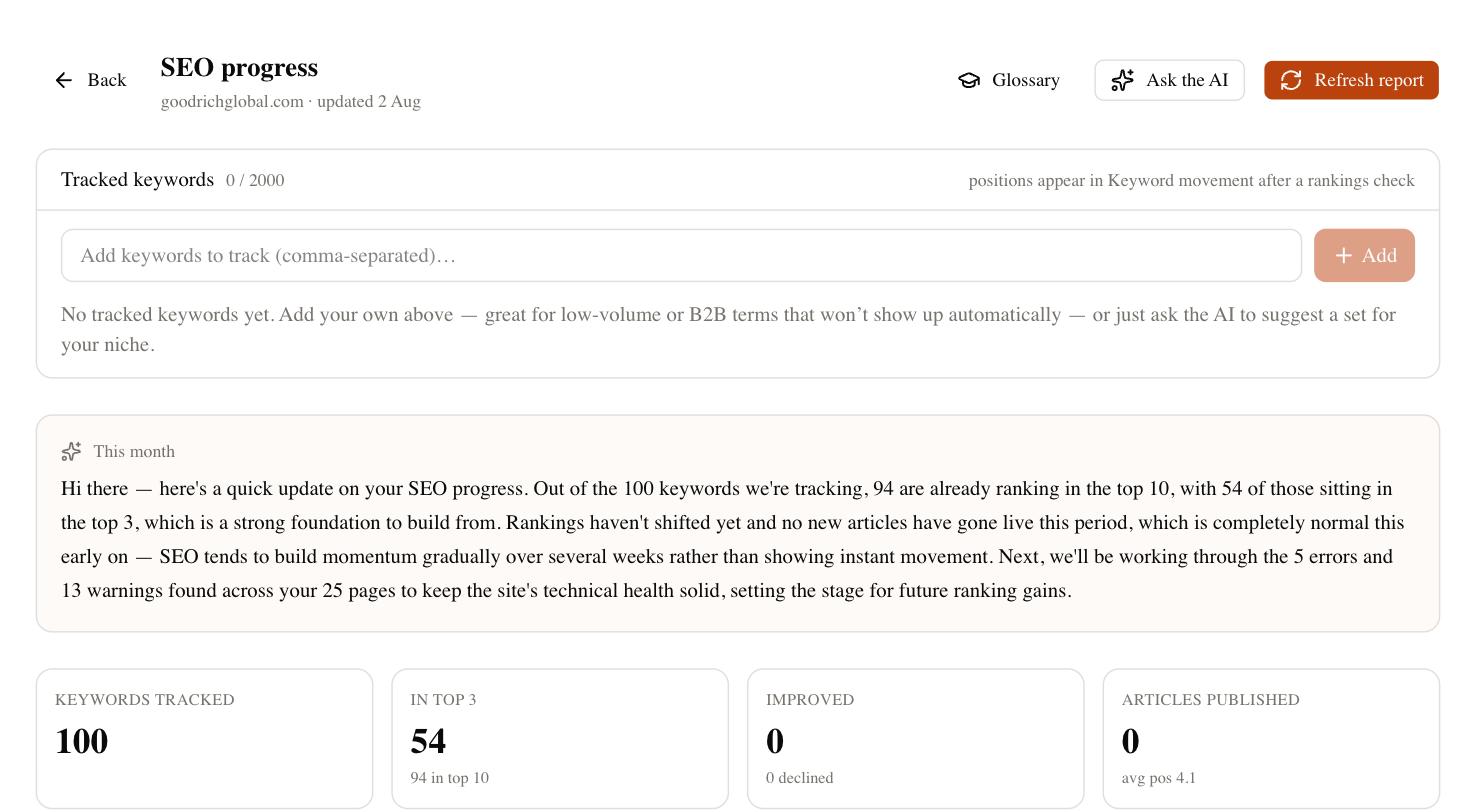
Two pieces matter especially for advisors. The AI writer drafts compliance-aware service and location pages with Claude, so you get real first drafts your team can fact-check and route through review instead of staring at a blank page. And Brand Radar tracks whether ChatGPT and Perplexity mention you when someone asks “who’s a good fee-only advisor near me” — because that search is already happening, and being invisible there is the new page-two. If you run a practice or an agency serving several advisor clients, the white-label dashboards let you hand each one a clean report without exporting a thing. Give any of it a full ranking cycle before you judge results; advisor SEO is a slow compounding win, not an overnight one.